New York is a leading US venture capital hub, second only to the Bay Area, and 18 of its most influential firms are profiled below. Recognizable names include Insight Partners, Tiger Global, and Union Square Ventures. A venture capital firm in New York usually operates with a structure of general partners (GPs) managing capital pooled from limited partners (LPs). Committed capital is deployed across a fund lifecycle that involves fundraising, investing, portfolio support, and eventual exits. New York’s VC market is uniquely influenced by its proximity to fintech, Wall Street, and enterprise buyers, differentiating it from Silicon Valley. The 18 profiled firms are presented with consistent identity attributes, including founding year, headquarters location, assets under management (AUM) or fund size, stage focus, sector thesis, and notable portfolio companies. New York venture firms primarily fund fintech, followed by sectors such as AI, SaaS and enterprise, consumer, healthtech, and climate technology. New York VC firms are ranked by size and activity, segmenting by sector and stage from pre-seed to growth. They compete for deals through strategies like deal-flow attraction, brand visibility, and self-marketing, working with specialist VC marketing agencies to strengthen their competitive edge. The article transitions from the New York venture market into the first profiled firm, Union Square Ventures.
1. Union Square Ventures
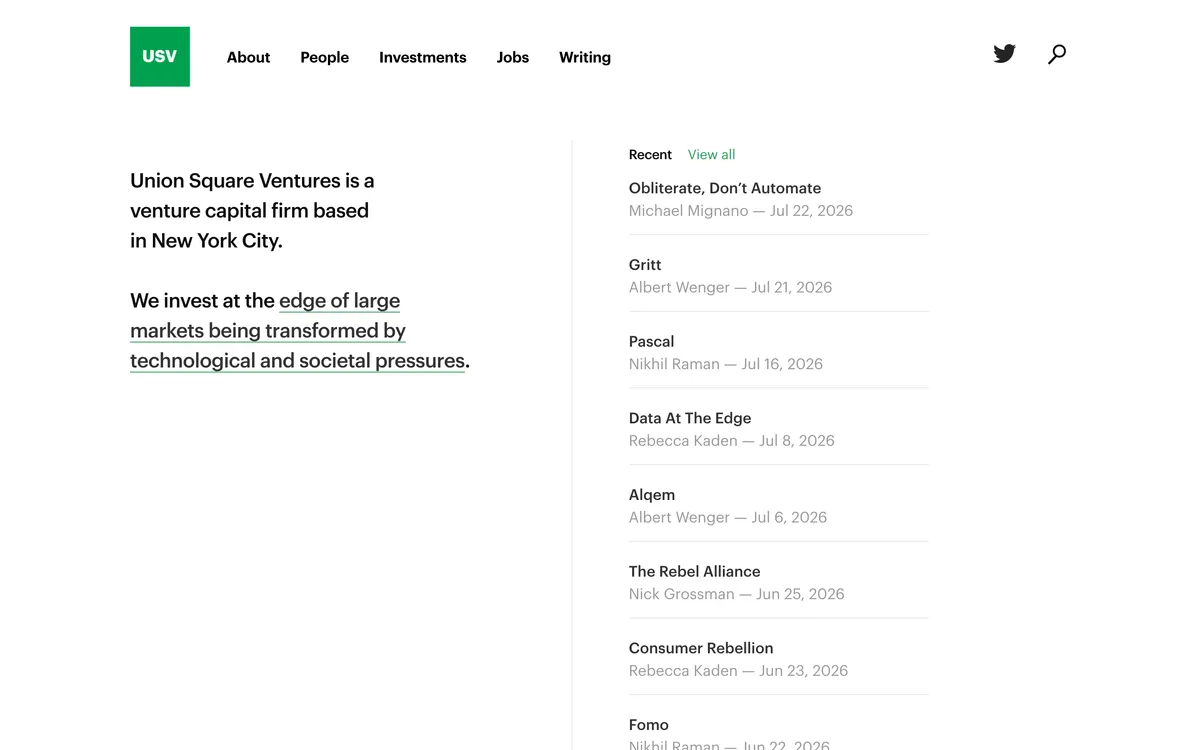
Union Square Ventures is an early-stage venture capital firm based in New York City, founded in 2003. Union Square Ventures is known for its investment thesis centered on network effects and internet-scale platforms, focusing primarily on early-stage technology companies. Union Square Ventures manages approximately $2.9 billion across multiple fund vintages according to fund-database records, with its most recent core fund being $275 million, as reported by reputable financial databases. The venture capital firm Union Square Ventures usually invests in Seed and Series A stages, frequently leading rounds with check sizes ranging from $1 million to $10 million, depending on the round size and investment conviction. Union Square Ventures’ portfolio includes notable companies such as Coinbase, Etsy, and Twilio, reflecting its strategic focus on businesses that can use strong user or platform networks to achieve growth and market impact. Union Square Ventures’ investment strategy is concentrated and thesis-driven, focusing on products that can compound through strong network effects. Union Square Ventures’s approach has positioned it as a key player in the venture capital market, supporting companies that strengthen access to knowledge and well-being through innovative technological products.
2. Insight Partners

Insight Partners is a venture capital and private equity firm headquartered in New York City. Founded in 1995, the firm has established itself as a global leader in software investment, focusing on growth-stage companies. With approximately $90 billion in regulatory assets under management as of December 31, 2025, Insight Partners ranks among the largest VC firms globally. Insight Partners specializes in backing high-growth technology and internet companies, focusing on ScaleUp strategies and SaaS economics. Insight Partners’ investment thesis centers on software and technology-enabled businesses, above all those ready to scale aggressively. The venture capital firm Insight Partners has invested in over 900 companies worldwide, with notable portfolio companies including Twitter, Shopify, Monday.com, Datadog, Wiz, MongoDB, and HelloFresh. Its typical investment ranges from $20 million to $100 million, reflecting its growth-equity orientation. Insight Partners’ ScaleUp methodology provides full operational support to portfolio companies, drawing on its large bench of operating partners to accelerate growth and optimize go-to-market strategies.
3. Thrive Capital

Thrive Capital, founded in 2009 by Josh Kushner, is a multi-stage venture capital firm based in New York City. Thrive Capital manages over $25 billion in assets, and closed its tenth flagship fund at more than $10 billion, twice the size of its previous vehicle and the largest in the firm’s history. Thrive Capital employs a multi-stage investment strategy, focusing on sectors such as internet and software, fintech, healthcare, and enterprise software. The venture capital firm Thrive Capital is renowned for its concentrated investment approach and long-term partnerships with founders. Notable portfolio companies include Stripe, Instagram, and OpenAI, which highlight Thrive Capital’s ability to identify and support high-impact technology companies. Thrive Capital usually invests with check sizes ranging from $10 million to over $100 million, frequently leading or co-leading investment rounds. Thrive Capital provides strategic guidance by taking board seats and offering access to its network of operators and industry experts. Thrive Capital’s influence in the New York venture market is reinforced by its track record of backing industry-defining companies. Thrive Capital’s hands-on approach to value creation and its commitment to supporting companies through successive funding rounds have established it as a sought-after investor.
4. Greycroft

Greycroft is a media and consumer technology venture capital firm founded in 2006, with dual headquarters in New York and Los Angeles. Greycroft manages approximately $4.36 billion in assets under management as of December 2024, across more than 900 investments, and focuses on investments from seed through growth stages. Greycroft has a strong focus on media, consumer, and technology-driven companies, including digital media, e-commerce, and enterprise software sectors.
Greycroft’s investment strategy centers on early-stage ventures, above all in media and consumer technology. The venture capital firm Greycroft usually invests in Series A and Series B rounds, with check sizes ranging from $1 million to $20 million. Notable companies in Greycroft’s portfolio include Bumble, The RealReal, Venmo, and Huffington Post. Greycroft’s positions highlight its knowledge of consumer fintech, marketplaces, and content platforms.
In 2023, Greycroft closed its newer flagship vehicles with more than $980 million combined. Greycroft is known for its bicoastal presence and working knowledge of consumer behavior and media trends. Bicoastal positioning allows Greycroft to use both coasts’ entrepreneurial markets, making it a go-to investor for founders building consumer-facing businesses that benefit from brand, network effects, and content-driven growth strategies.
5. Bessemer Venture Partners

Bessemer Venture Partners, founded in 1911, is one of the oldest venture capital firms in the United States, with a substantial presence in New York City. Bessemer is renowned for its investment focus on cloud computing, enterprise software, fintech, and healthcare technology. Bessemer manages more than $20 billion in assets while investing out of its twelfth fund, according to the firm’s disclosures, making it a major player in the venture capital market. According to PitchBook, Bessemer’s assets under management were over $20 billion as of 2024. Bessemer’s investment strategy spans multiple stages, from seed to growth, allowing it to support companies throughout their development. Bessemer Venture Partners’ notable portfolio includes companies like Shopify, Twilio, LinkedIn, and Wix. The venture capital firm Bessemer Venture Partners is famous for its “anti-portfolio,” a list of successful companies it chose not to invest in, such as Apple, Google, and Facebook. Typical investment sizes range from $1 million at the seed stage to $50 million for later-stage investments, providing flexible funding options to its portfolio companies.
6. Lux Capital

Lux Capital is a deep-tech venture capital firm based in New York City, founded in 2000. Lux Capital focuses on deep tech and frontier technologies, investing in areas such as artificial intelligence (AI), robotics, space exploration, defense, biotechnology, and advanced computing. Lux Capital operates across several investment stages, with a particular focus on early-stage and Series A investments. The venture capital firm Lux Capital manages $7 billion in assets, according to fund-database records in assets under management, as supported by a recent directory source citing a January 2026 close of Lux Ventures IX at $1.5 billion. Lux Capital’s investment thesis revolves around transforming science fiction into science fact, backing companies that push the boundaries of technological innovation. Notable portfolio companies include Anduril, Applied Intuition, Hugging Face, Runway, Eikon Therapeutics, Ramp, and Hadrian. Lux Capital usually invests amounts ranging from $1 million to $10 million, depending on the stage and leadership role. Lux Capital’s strategic approach combines capital deployment with hands-on guidance, helping portfolio companies work through the complications of commercializing advanced technologies.
7. FirstMark Capital
FirstMark Capital is an early-stage venture capital firm based in New York City, founded in 2008. FirstMark does not publish a firm-level assets-under-management figure, and it stands as a cornerstone investor in the New York startup community. FirstMark Capital focuses primarily on seed and Series A investments, with check sizes ranging from $250,000 to $10 million. FirstMark is renowned for its thesis-driven approach, focusing on network-driven and product-led companies across sectors such as software, consumer internet, and fintech. Notable portfolio companies include high-profile technology firms like Pinterest, Shopify, Airbnb, Discord, and Riot Games. FirstMark Capital is known for its hands-on partnership model, working closely with founders to help build category-defining companies. A commitment to community building and founder support has positioned FirstMark as one of New York’s most influential early-stage investors. The venture capital firm FirstMark Capital hosts the annual Hardwired NYC conference, which connects portfolio companies, limited partners, and the broader New York tech community, further solidifying its role in establishing the city as a major technology hub.
8. RRE Ventures

RRE Ventures is an early-stage venture capital firm based in New York City, established in 1994. RRE Ventures is known for its early-stage investment focus, above all in seed and Series A rounds. RRE Ventures does not disclose a firm-level assets-under-management figure, and its portfolio spans over 400 companies with more than 125 exits. RRE Ventures’s investment thesis focuses on technology-enabled sectors, including software, fintech, and digital infrastructure. RRE Ventures usually invests between $1 million and $15 million per company, depending on the stage and the needs of the business. The venture capital firm RRE Ventures is noted for its strategic guidance and operational support, providing useful resources to its portfolio companies. Notable investments in RRE’s portfolio include Datadog, Olo, Venmo, and Giphy, showcasing its commitment to backing innovative enterprises with strong growth potential. Headquartered in Manhattan, RRE Ventures plays a substantial role in New York’s venture capital market. RRE Ventures builds relationships with exceptional founders and investing in businesses that demonstrate capital efficiency and sustainable competitive advantages. Drawing on a wide network and industry knowledge, RRE Ventures continues to be a key player in the venture capital market, supporting companies that drive technological advancement and industry transformation.
9. Lerer Hippeau

Lerer Hippeau is a seed and early-stage venture capital firm based in New York City, established in 2010. Lerer Hippeau is known as a leading seed and early-stage investor, focusing on consumer and enterprise technology companies. Lerer Hippeau does not publish a firm-level assets-under-management figure, and its typical check sizes ranging from $500,000 to $3 million. The cheque range lets Lerer Hippeau to support startups at decisive early stages, providing both capital and strategic guidance. Lerer Hippeau’s investment thesis focuses on identifying and nurturing category-defining companies. Lerer Hippeau’s notable portfolio includes successful brands such as Allbirds, Casper, Warby Parker, Glossier, and Compass. Those portfolio companies show the firm’s focus on consumer-facing and enterprise technology businesses. Lerer Hippeau’s partners bring wide operational skill, offering strategic support in product development, market strategy, and scaling operations. Lerer Hippeau positions itself as a cornerstone of New York’s startup community, drawing on long-standing industry connections and a hands-on approach to portfolio management. Lerer Hippeau’s operational skill and strategic counsel make it a preferred partner for founders pursuing more than just financial investment. A seed-led approach has solidified Lerer Hippeau’s reputation as a key player in the venture capital market, above all in New York City.
10. BoxGroup
BoxGroup is a seed and pre-seed venture capital firm based in New York City, established in 2007. BoxGroup is known for its focus on early-stage investments, frequently writing initial checks ranging from $250,000 to $1 million. BoxGroup’s investment strategy focuses on backing ambitious founders and supporting category-defining technology startups. BoxGroup’s headquarters are in Manhattan, positioning it as a decisive player in New York’s active startup community. BoxGroup’s investment portfolio includes notable companies such as Ramp, Plaid, Airtable, Cursor, Warby Parker, and SeatGeek. Those positions highlight BoxGroup’s broad sector thesis, which is not limited to a particular industry but rather focuses on high-impact technology ventures. BoxGroup’s model combines early-stage funding with follow-on capital, allowing it to support the growth of its portfolio companies beyond the initial investment phase. BoxGroup raises across two vehicle types, an early-stage fund and an opportunity fund for follow-on investments, an approach that reinforces the firm’s commitment to maintaining its role as a seed and pre-seed anchor in New York. The strategic approach of BoxGroup ensures that it remains well-positioned to capitalize on early-stage opportunities and support the long-term growth of its portfolio companies.
11. Primary Venture Partners
Primary Venture Partners is a seed-stage venture capital firm based in New York City. Founded in 2015, it serves as a cornerstone investor for early-stage startups in the region. Primary closed its $625 million Fund V in February 2026, the largest dedicated New York seed vehicle in recent years, making it a major player in New York’s venture capital market. Primary Venture Partners usually invests with check sizes ranging from $5 million to $10 million, focusing on companies that demonstrate strong potential for growth. Primary’s investment strategy centers on partnering with mission-driven founders across several sectors, including software, fintech, consumer, and healthtech. Notable portfolio companies include K Health, Lyric, and Teleskope, reflecting Primary’s commitment to supporting innovative products in large market opportunities. Primary Venture Partners is known for its hands-on approach, providing both capital and strategic support to help entrepreneurs work through the decisive early stages of company building. Positioned as a seed-stage anchor in New York, Primary Venture Partners differentiates itself through close founder relationships and sector knowledge. Primary is known for its ability to lead funding rounds and shape companies from their inception to scalable growth. Seed-stage focus makes Primary a preferred choice for entrepreneurs pursuing a lead investor with strong operational support.
12. Inspired Capital
Inspired Capital is a New York-based venture capital firm founded in 2019 by Alexa von Tobel and Penny Pritzker, with headquarters in New York City. Inspired Capital focuses on early-stage investments, primarily leading seed and Series A rounds. Inspired Capital invests across a series of funds, positioning itself as a notable player in New York’s venture market. The investment strategy of Inspired Capital is broad, focusing on partnerships with ambitious, founder-led companies across several sectors. Notable portfolio companies include Ramp, Thrasio, and Eight Sleep, reflecting its sector-agnostic approach within technology. The venture capital firm Inspired Capital usually writes checks ranging from $500,000 to $20 million, with a core investment range of $1 million to $15 million. Inspired Capital’s approach combines substantial fund capacity with flexible check sizing, allowing it to support high-impact businesses through their growth journeys. Inspired Capital’s hands-on partnership model draws on the operational experience of its founders, providing strategic guidance and network access to its portfolio companies.
13. IA Ventures

IA Ventures is a New York-based venture capital firm specializing in pre-seed and seed-stage investments. Founded in 2010, the firm is headquartered at 920 Broadway in Manhattan. IA Ventures focuses primarily on data-driven companies, applying a thesis that has evolved from “big data” to include broader data intelligence, AI, fintech, cybersecurity, and SaaS sectors. IA Ventures does not publish a firm-level fund total, and its fund vintages including a $50 million first fund, a $105 million second fund, and subsequent funds around $160 million each. The typical investment check size for IA Ventures ranges from $250,000 to $750,000, although there is flexibility depending on the round and fund vintage. The venture capital firm IA Ventures is known for backing innovative companies that transform passive data into active assets, with notable portfolio companies including Datadog, MongoDB, and Acorns. IA Ventures positions itself as a key player in New York’s early-stage investment market, competing alongside other seed specialists to support the city’s next generation of data-intelligent startups.
14. Bowery Capital

Bowery Capital is a New York-based venture capital firm established in 2013. Bowery Capital specializes in early-stage investments in the B2B software and enterprise technology sectors. Bowery Capital is headquartered at 123 Lafayette Street, New York City. The venture capital firm Bowery Capital does not disclose a firm-level assets figure, and its fund sizes range from $60 million to $70 million, according to industry fund-tracking sources. Bowery Capital focuses on partnering with technical founders to build high-impact enterprise products. Bowery Capital invests in seed and Series A rounds, offering check sizes between $100,000 and $5 million, with a sweet spot around $1.5 million. Its investment thesis focuses on companies with strong product-market fit and clear paths to recurring revenue. Notable portfolio companies include Codecademy and Auth0, which have benefited from Bowery’s sector knowledge. Bowery Capital’s value-added approach includes dedicated platform resources for talent acquisition, business development, and go-to-market strategy. Bowery Capital’s concentrated focus on the B2B market makes it a key player among New York’s enterprise-focused venture capital firms.
15. Phira Ventures
Phira Ventures is a founder-first venture studio with offices in New York and Lisbon, which distinguishes it from the fund managers listed above. Phira builds purpose-driven companies alongside founders rather than managing a fund, combining capital with co-founders and operating support across marketing, product, technology, and strategy, and it works at pre-seed and seed-stage investments. Phira Ventures usually writes checks ranging from €50k to €500k. Phira’s investment strategy focuses on active involvement in venture creation and operational support for founders. Phira Ventures publishes no fund-level figures, which follows from its studio model rather than a fund structure. The studio positions itself as a team of builders and strategists, reflecting its commitment to purpose-driven entrepreneurship.
16. Fintech Collective

Fintech Collective is a New York-based venture capital firm specializing in fintech investments. Founded in 2012, it focuses on financial technology sectors, including fintech infrastructure, payments, and wealth management. Fintech Collective does not publish a firm-level assets-under-management figure across multiple funds, according to established fund databases. The venture capital firm Fintech Collective primarily targets early-stage investments, focusing on seed and Series A rounds. Fintech Collective’s investment thesis centers on supporting technical founders who understand the complications of financial services. Notable portfolio companies include Betterment, Plaid, and Chainalysis, which reflect its commitment to innovative fintech products. Typical check sizes range from $500,000 to $5 million, with provisions for follow-on investments. Fintech Collective draws on New York City’s financial sector, positioning itself as a key player in the fintech venture market. Its specialization in digital banking and capital markets technology reinforces its strategic approach to transforming financial services. Working across those areas, Fintech Collective aims to drive the next generation of financial infrastructure development.
17. QED Investors
QED Investors is a venture capital firm specializing in fintech investments. Founded in 2007 by Nigel Morris and Frank Rotman, the firm is headquartered in Alexandria, Virginia, with a substantial presence in New York City. QED Investors manages approximately $4 billion in assets and closed $925 million across two funds in 2023, a $650 million early-stage vehicle and a $275 million growth fund, focusing on early-stage to growth-stage investments in financial technology companies. QED is known for its hypothesis-driven approach, focusing on the transformation of financial services through technology and innovation. QED Investors’ investment strategy targets disruptive financial services and fintech infrastructure. QED’s portfolio includes notable companies such as Klarna, Nubank, Credit Karma, SoFi, and Plaid. QED’s portfolio companies have reshaped the fintech market, reshaping consumer and business financial services. QED usually writes initial checks ranging from $3 million to $10 million, supporting portfolio companies through follow-on rounds with larger investments as they scale. QED Investors draws on the founders’ backgrounds as former Capital One executives, providing strategic guidance on risk management, regulatory navigation, product development, and customer acquisition. Operational skill of that kind matters most in the heavily regulated fintech sector. According to PitchBook data, QED ranks among the most active fintech investors globally, completing many deals annually and establishing itself as a key partner for entrepreneurs building the future of financial services.
18. Tiger Global
Tiger Global, founded in 2001 by Chase Coleman, is a crossover investment firm based in New York City. Tiger Global manages approximately $69.6 billion in assets, according to fund-tracking data reported by Bloomberg in December 2025, positioning it as one of the largest players in the venture capital market. Tiger Global employs a crossover and growth-stage strategy, drawing on its hedge-fund heritage to invest in both public and private markets. A crossover approach allows Tiger Global to make rapid investment decisions, moving from initial contact to term sheet within days. The venture capital firm Tiger Global primarily focuses on growth-stage investments in sectors such as consumer internet, software, and fintech. Typical investment sizes range from $10 million to over $100 million, above all in later-stage rounds. Notable portfolio companies include Stripe, Spotify, and Facebook, reflecting its focus on high-growth technology platforms. Tiger Global’s investment strategy is defined by speed and founder-friendly terms, making it a preferred partner for many entrepreneurs. Tiger Global exemplifies the scale and sophistication of New York’s venture capital firms, combining Wall Street’s financial acumen with Silicon Valley’s growth ambitions. The dual approach defines Tiger Global’s distinct position in the market and reinforces its influence within the broader category of New York venture capital firms.
What are venture capital firms in New York?
Venture capital firms in New York are institutional investors that raise pooled funds from limited partners and deploy them into startups based in the city and beyond. New York ranks as the largest United States venture market outside the Bay Area, and its firms range from pre-seed specialists writing $250,000 cheques to crossover managers deploying above $100 million per round.
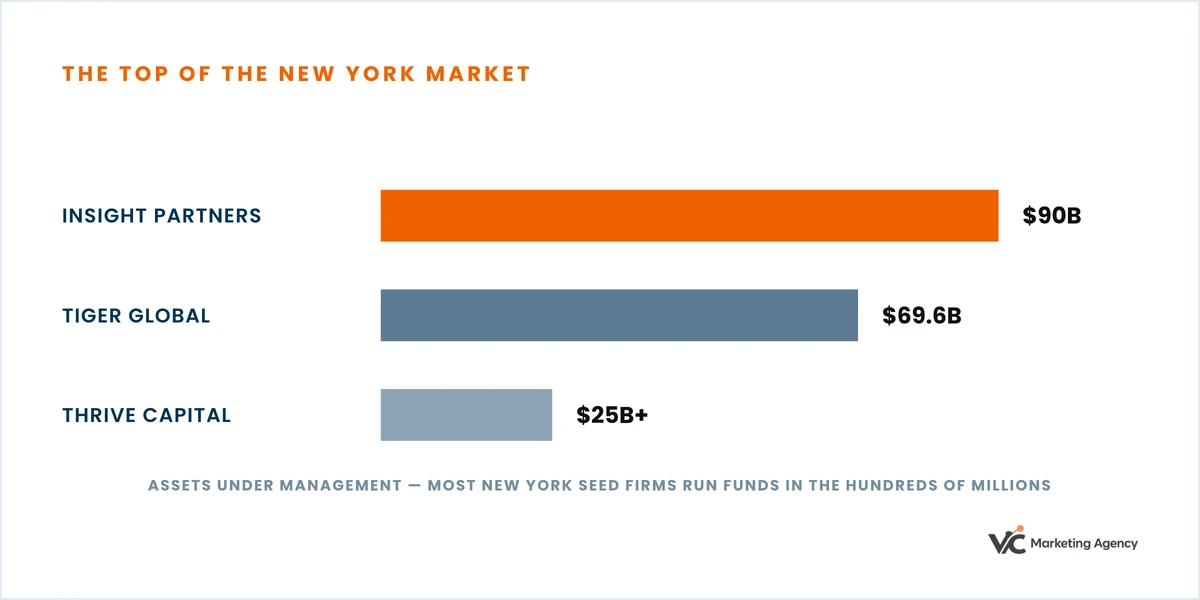
Scale separates the top of the market sharply from the rest. Insight Partners holds over $90 billion in regulatory assets under management as of 31 December 2025 according to the firm’s own disclosure, Tiger Global approximately $69.6 billion, and Thrive Capital over $25 billion, while most of the city’s seed firms operate funds measured in the hundreds of millions.
Proximity to Wall Street shapes what the city funds. New York firms concentrate on fintech more heavily than any other American market, supported by the financial infrastructure, regulatory knowledge, and talent already resident in the city.
What do New York VC firms fund?
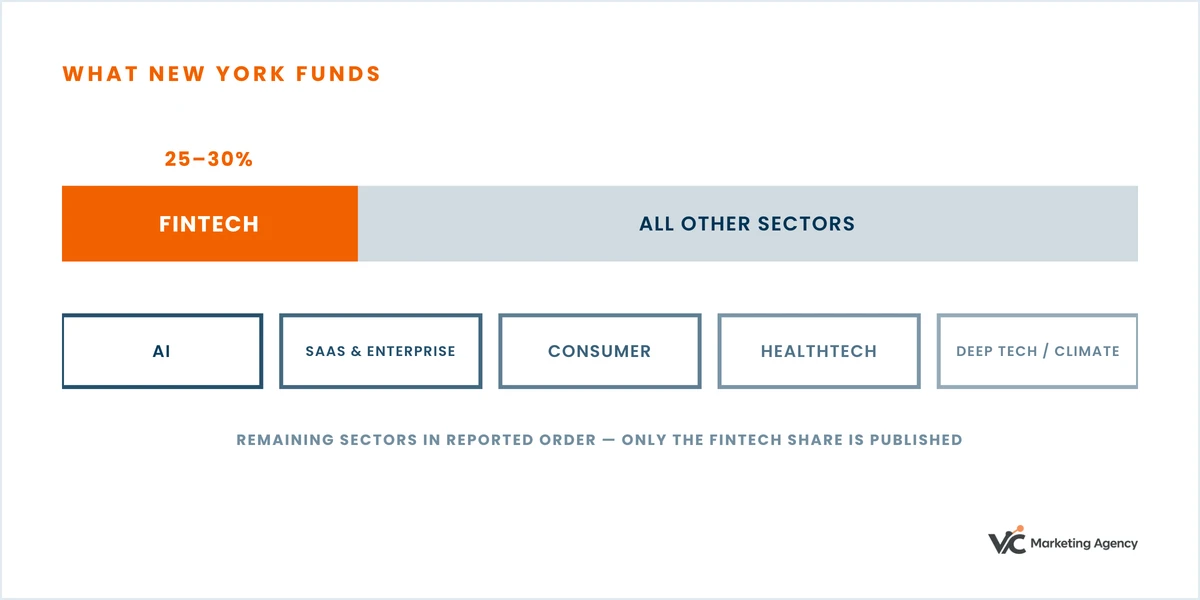
New York venture capital firms predominantly invest in fintech, drawing on the city’s proximity to Wall Street and its financial services knowledge. Beyond fintech, New York managers fund sectors such as artificial intelligence (AI), software-as-a-service (SaaS) and enterprise technology, consumer technology, healthtech, and deep tech/climate innovation. The distribution reflects New York’s dual identity as a financial hub and a burgeoning tech center.
- Fintech: Dominates investment due to the city’s financial infrastructure and talent pool.
- AI: Attracts funding for its potential to solve complex business problems.
- SaaS and Enterprise Technology: Gains substantial backing for improving business operations.
- Consumer Technology: Benefits from New York’s role as a media and commerce center.
- Healthtech: Draws investment thanks to the region’s medical institutions and research capabilities.
- Deep Tech/Climate: Emerging focus areas, with firms like Lux Capital leading in frontier technology investments.
According to industry funding reports, fintech consistently captures the largest share of venture capital in New York, representing 25-30% of total deal volume, significantly higher than the national average.
How do New York VC firms operate?
New York venture capital firms operate through a structured model involving limited partners (LPs) and general partners (GPs). LPs, usually institutional investors, provide the capital, while GPs manage investment decisions and fund operations.
The fund lifecycle spans approximately 10 years, with the initial 3-5 years focused on capital deployment. During this period, GPs actively source deals through networks, referrals, and proactive outreach.
Once investments are made, firms offer value-added support, including strategic guidance and operational skill. Board participation is common, with GPs securing board seats or observer roles to influence strategic decisions. As portfolio companies mature, New York VC firms reserve capital for follow-on rounds to maintain ownership stakes and signal confidence to other investors. Staged deployment is standard across the New York VC market, holding sustained support and governance through the investment lifecycle.
Which New York VC firms are largest?
The largest venture capital firms in New York by assets under management (AUM) are Insight Partners and Tiger Global. Insight Partners manages approximately $90 billion, making it a dominant force in the New York VC market. Tiger Global, known for its crossover hedge fund heritage, commands substantial assets, positioning it alongside Insight Partners as a leading capital allocator in the city.
Other substantial growth-scale investors include Thrive Capital and General Atlantic, which focus on late-stage ventures and have substantial portfolios and exit histories.
The largest managers illustrate New York’s strength in growth-stage investing, above all in sectors like fintech and enterprise technology. Asset concentration among the largest managers highlights their capacity to write large checks into later-stage companies and participate in multiple follow-on rounds. Size stratification sets up how the most active investors are ranked by deal volume below.
Which New York VC firms are most active?
New York’s venture capital market features several firms that consistently lead in deal volume. The most active managers are known for frequent investments and engagement in the startup community. The most active New York VC firms by investment volume are listed below.
- BoxGroup: Known for its prolific early-stage investments, BoxGroup maintains a high deal count, frequently leading in seed-stage funding.
- Lerer Hippeau: Lerer Hippeau is a seed-stage investor, deploying capital across many startups on a steady cadence.
- Primary Venture Partners: With a focus on early-stage investments, Primary Venture Partners continues to be a key player in the New York VC scene.
- IA Ventures: Specializing in data-driven companies, IA Ventures maintains a steady investment pace, above all in the pre-seed and seed stages.
- Insight Partners: At the growth stage, Insight Partners showcases exceptional deal volume, investing in high-growth tech and internet companies.
- Union Square Ventures: Known for its thesis-driven approach, Union Square Ventures remains highly active across several sectors.
Active managers shape New York’s venture capital environment by consistently supporting emerging startups and driving innovation.
Which New York VC firms have notable portfolios?
New York venture capital firms with notable portfolios include several key players known for their strategic investments and successful exits. The following firms are known for their standout companies:
- Union Square Ventures: Known for its network-effects investment thesis, Union Square Ventures has invested in prominent companies like Coinbase, Etsy, and Twilio, showcasing its strength in early-stage internet platforms.
- Thrive Capital: Founded by Josh Kushner, Thrive Capital has built a prestigious portfolio including Stripe, Instagram, and OpenAI, highlighting its success in backing high-impact consumer and software companies.
- Insight Partners: With a focus on software and ScaleUp growth, Insight Partners boasts a portfolio of high-growth technology firms such as Databricks and Shopify, drawing on its substantial assets under management.
- BoxGroup: As a pre-seed and seed specialist, BoxGroup has made early investments in companies like Plaid and Airtable, demonstrating its consistent early-stage success in technology ventures.
- Lux Capital: Specializing in deep tech and frontier technology, Lux Capital has invested in innovative companies like Anduril and Varda Space Industries, reflecting its commitment to frontier science and technology.
Those portfolios show the breadth and strength of New York’s venture capital market, each contributing to the city’s reputation as a leading hub for innovation and investment.
Which New York VC firms are actively investing now?
Several New York venture capital firms are currently deploying capital actively, reflecting their ongoing investment strategies for 2025 to 2026. Currently active managers stand out for strong engagement in the market.
- BoxGroup: Leads NYC startup activity, recording substantial deal volume.
- Insight Partners: Known for repeat investments, maintaining high visibility.
- Union Square Ventures: Union Square Ventures continues to be an active investor in the market.
- Thrive Capital: Actively invests with a focus on high-growth opportunities.
- Lerer Hippeau: Remains a key player in early-stage investments.
Recent fundraises support those managers and fuel continued deployment across several stages.
Which New York VC firms have recently raised new funds?
Several New York venture capital firms have recently closed new funds, showcasing their active investment strategies. The recent closings, fund sizes, and dates are listed below.
- Insight Partners: Closed Fund XIII and Opportunities Fund II on January 16, 2025, raising $12.5 billion.
- Thrive Capital: Announced the close of Thrive X on February 17, 2026, with over $10 billion, including $1 billion for early-stage investments.
- Work-Bench: Raised $160 million for Fund IV on May 13, 2025, focusing on early-stage software investments.
- Union Square Ventures: Closed its Opportunity Fund III at $250 million in 2024, continuing its network-effects investment strategy.
- Lux Capital: Raised $1.15 billion across two funds in late 2023, supporting frontier and deep tech ventures.
- Lerer Hippeau: Closed its sixth flagship fund at $180 million in 2023, maintaining its seed and early-stage investment focus.
The fund closings reflect an active investment market in New York, with firms actively expanding their capital to support several stages and sectors.
Which New York VC firms specialize by sector?
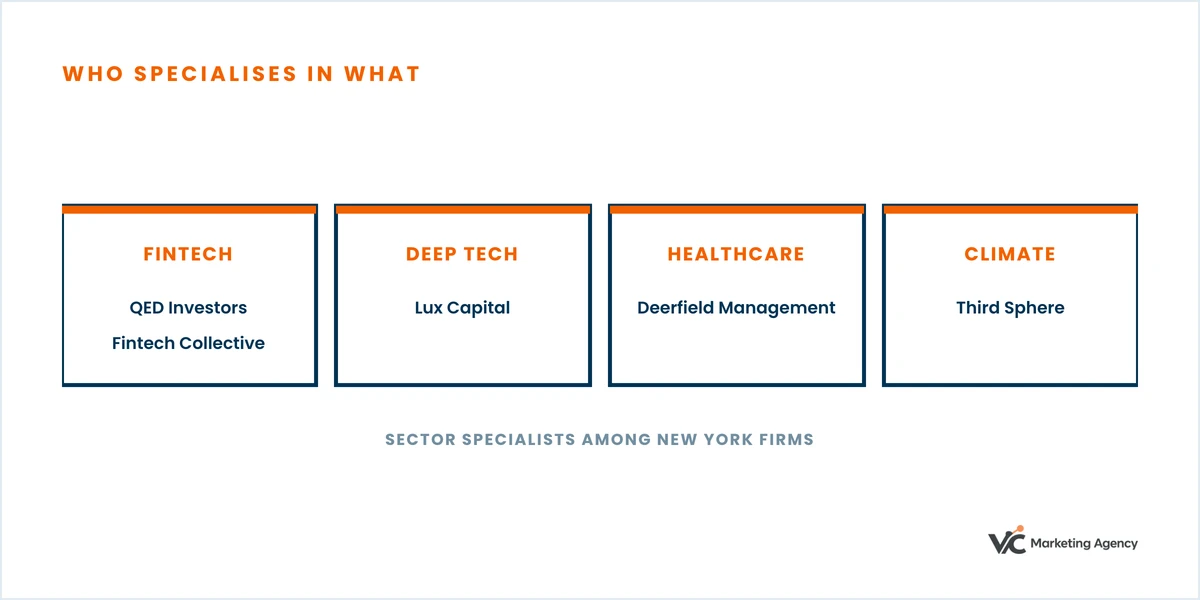
New York venture capital firms specialize by sector to use domain knowledge and build competitive advantages. QED Investors and Fintech Collective are prominent specialists in fintech, reflecting the city’s financial hub status. QED Investors focuses exclusively on fintech, investing in areas like banking, lending, and insurance. Fintech Collective, based in Union Square, targets early-stage fintech companies across payments and wealth management.
Lux Capital distinguishes itself in deep tech and frontier technologies, investing in AI, biotech, and robotics. Tiger Global’s strategy aligns with supporting breakthrough innovations in science and technology. Deerfield Management focuses on healthcare and biotech ventures, while Third Sphere focuses on climate-focused investments in clean tech and sustainability sectors.
Sector specialization among New York VC firms allows for targeted investment strategies, strengthening their ability to support portfolio companies with specialized knowledge and networks. Sector focus pairs with stage-based segmentation, setting the scene for which firms invest at pre-seed stages below.
Which New York VC firms invest at pre-seed?
New York hosts several venture capital firms that specialize in pre-seed investments. Pre-seed managers provide the earliest institutional funding to startups, enabling them to develop their ideas and reach initial milestones. The prominent pre-seed investors in New York are listed below.
- BoxGroup: Known for investing as early as the pre-seed round, BoxGroup supports technology ventures, above all in finance, FinTech, and impact investing.
- Lerer Hippeau: Lerer Hippeau is a key player in pre-seed and seed-stage investments, focusing on helping founders validate their ideas and achieve product-market fit.
- Primary Venture Partners: Specializing in pre-seed and seed investments, Primary Venture Partners provides both capital and hands-on support to startups in tech sectors.
- IA Ventures: Positioned as a pre-seed and seed investor, IA Ventures targets companies working with big data applications, transforming passive data into active business assets.
Which New York VC firms invest at seed?
New York’s venture capital market includes several prominent seed-stage investors. Seed managers provide first institutional funding to startups. Below are some of the key seed-stage investors in New York:
- BoxGroup: Known for its focus on technology ventures, BoxGroup invests from pre-seed to Series A, focusing on finance, FinTech, and impact investing.
- Lerer Hippeau: As a major player in early-stage investing, Lerer Hippeau supports companies across consumer, media, and B2B software sectors.
- Primary Venture Partners: Primary Venture Partners concentrates on seed-stage investments, with a commitment to helping founders achieve product-market fit and prepare for Series A funding.
Which New York VC firms invest at Series A?
Several prominent venture capital firms in New York actively invest at the Series A stage, providing central funding to help startups scale their operations. The main Series A investors include:
- Union Square Ventures: Known for its network-effects investment thesis, Union Square Ventures supports innovative companies like Coinbase, Etsy, and Twilio. Union Square Ventures usually invests in Seed and Series A rounds, offering checks ranging from $3 million to $8 million.
- FirstMark Capital: Positioned as an early-stage anchor in New York, FirstMark Capital focuses on enterprise software, fintech, and internet companies. FirstMark Capital partners with founders at the inflection point of product-market fit, enabling them to scale rapidly.
- Greycroft: Greycroft specializes in media and consumer technology investments. Greycroft’s Series A funding supports companies aiming to expand their market presence and technological capabilities.
- Bowery Capital: Concentrating on early-stage B2B and enterprise software, Bowery Capital provides Series A funding to startups developing innovative business products.
- Lerer Hippeau: Although primarily known for seed investments, Lerer Hippeau participates in Series A rounds for promising companies in its portfolio and beyond.
Series A managers offer broad knowledge and resources to support startups through their decisive growth phases.
Which New York VC firms invest at growth stage?
Growth-stage venture capital firms in New York play a decisive role in scaling companies ready for rapid expansion. The leading firms in this category are known for their substantial investments and strategic support.
- Insight Partners: Insight Partners is a growth-stage investor with approximately $90 billion in assets under management. Insight Partners focuses on software and ScaleUp companies, providing capital and operational support to accelerate growth.
- Tiger Global: Known for its crossover and late-stage investment strategy, Tiger Global draws on its hedge-fund roots to invest in internet and software companies. Tiger Global is known for deploying large capital to fuel company expansions.
- Thrive Capital: Founded by Josh Kushner, Thrive Capital engages in multi-stage investments with a strong focus on growth phases. Thrive Capital has notable investments in companies like Stripe, Instagram, and OpenAI, focusing on internet and software sectors.
Growth-stage managers are defined by their ability to provide large capital infusions and strategic guidance to help companies scale effectively.
How do New York VC firms compete for deals?
New York venture capital firms compete intensely for deals by differentiating themselves through specialized sector knowledge and founder-facing reputation. In a competitive market, firms strive to win early access to promising startups by showcasing their distinct value propositions. Those value propositions include working knowledge of named sectors like fintech or deep tech, as exemplified by QED Investors and Lux Capital. Firms build strong reputations by demonstrating successful track records, offering founder-friendly terms, and providing operational support beyond just capital.
Firms invest heavily in building relationships within the startup community. Competing on access means maintaining active presence in founder communities and participating in events and partnerships with accelerators. The ability to move quickly on term sheets and offer favorable terms matters in securing competitive deals.
Beyond relationship capital, New York VC firms strengthen their competitiveness through brand visibility and thought leadership. Establishing themselves as authorities in their respective categories ensures that founders actively seek them out. A competitive field of that kind shapes how firms attract deal flow from founders.
How do VC firms attract deal flow from founders?
Venture capital firms attract deal flow from founders through a combination of strategic channels. The channels include portfolio referrals, where satisfied founders recommend their investors to peers, and active sourcing, where firms proactively identify promising startups via social platforms and market research.
- Portfolio Referrals: Satisfied founders recommend their investors to peers, creating a trusted network.
- Founder Networks: Firms engage with communities and events to maintain visibility where entrepreneurs gather.
- Active Sourcing: Partners and associates identify startups through social media and accelerator monitoring.
- Reputation: A firm known for supportive terms and successful exits naturally attracts interest.
Sourcing across several channels raises the importance of brand visibility, which the next section covers.
What is the importance of brand visibility matter for VC firms?
Brand visibility matters for venture capital firms as it directly influences deal flow, enhances founder trust, and differentiates firms from competitors. Research indicates that a strong, visible brand helps VC firms attract better opportunities and establish credibility in a crowded market. Visibility ensures that firms are easily remembered by founders, increasing the likelihood of being included in competitive funding rounds. According to industry studies, firms with high brand visibility experience higher rates of founder engagement, which decides access to quality investments. Brand visibility aids deal flow, recruiting and attracting high-quality limited partners, thereby creating a lasting competitive advantage. The importance of brand visibility naturally leads to the question of how firms market themselves to maintain and strengthen this visibility.
How do venture capital firms market themselves?
Venture capital firms employ a variety of marketing strategies to strengthen visibility and attract deal flow. The most effective approaches are outlined below.
- Content and Thought Leadership: Firms publish market analysis, investment theses, and expert articles to demonstrate authority.
- PR and Media Engagement: They engage with media through press releases, interviews, and podcasts to broaden their reach.
- Events and Community Building: Hosting summits, panels, and networking events helps firms establish direct relationships with potential portfolio companies.
- Digital and Social Presence: Maintaining active profiles on platforms like LinkedIn and Twitter keeps firms visible to founders and investors.
- Founder-Facing Brand Building: Developing a strong brand identity through success stories and testimonials ensures that firms remain memorable to entrepreneurs during fundraising.
Those marketing strategies build a strong market presence, leading firms to consider hiring specialist VC marketing agencies to extend their efforts further.
Why Venture Capital Firms Should Hire a VC Marketing Agency
Venture capital firms should hire a VC marketing agency to strengthen their competitive edge in attracting top-tier deal flow and increasing brand visibility. In a densely populated market like New York, where firms vie for the attention of the best founders, a marketing agency for venture capital firms provides the strategic knowledge necessary to stand out. Specialist agencies help firms articulate an investment thesis, write thought leadership content, and establish a strong digital and PR presence, which matters for drawing in high-quality opportunities from both founders and limited partners.
A VC marketing agency offers targeted services that include content strategy development, media relations, and branding campaigns built for the venture capital market. Support of that kind matters for firms like Union Square Ventures, Insight Partners, and Thrive Capital, which aim to maintain strong deal flow and a durable brand reputation.
Working with a VC marketing agency lets New York firms hold precise positioning, strengthen their market authority, and secure a more consistent influx of promising investment opportunities.