Starting a venture capital firm runs through a defined sequence: define an investment thesis, register with the Securities and Exchange Commission (SEC), raise a first fund from limited partners, source and close first deals, build back-office operations, support portfolio companies, and set an investment decision process for future deals. A venture capital firm is separate from the fund it runs; the firm acts as the management company or general partner (GP) that raises and manages funds, while the fund is the vehicle that pools capital and invests in startups.
Launching one demands preparation on several fronts. A venture capital firm’s main function is to identify promising startups, deploy capital, and produce returns for limited partners. Before launching, founders need a track record of investments, a founding team, a working network, warehoused deals, and enough capital to cover early operations. New firms range from micro VCs running sub-$50 million funds to corporate venture arms tied to a parent company, and growth comes through deal flow, portfolio support, and marketing that attracts limited partners.
Starting a venture capital firm carries real risk, from ten-year illiquidity to the difficulty of raising a second fund. The rewards are management fees, carried interest, and a network of influence across the startup market. A sustainable firm turns fund management into a lasting franchise, and it starts with an investment thesis that governs every decision that follows.
Step 1 — Define Your Venture Capital Firm’s Investment Thesis
Defining an investment thesis is the first step in starting a venture capital firm. The thesis sets the framework that guides future investment decisions and separates the firm in a competitive market.
An investment thesis states six dimensions: the stage the firm invests at (pre-seed, seed, Series A, or growth), the sector it targets (fintech, healthcare, SaaS, or climate tech), the geography it covers (local, regional, national, or global), the check size per deal (from $100K for nano funds to several million for larger ones), the differentiation the firm brings that competitors cannot, and the why-now rationale drawn from market timing, regulatory change, or technological shift.
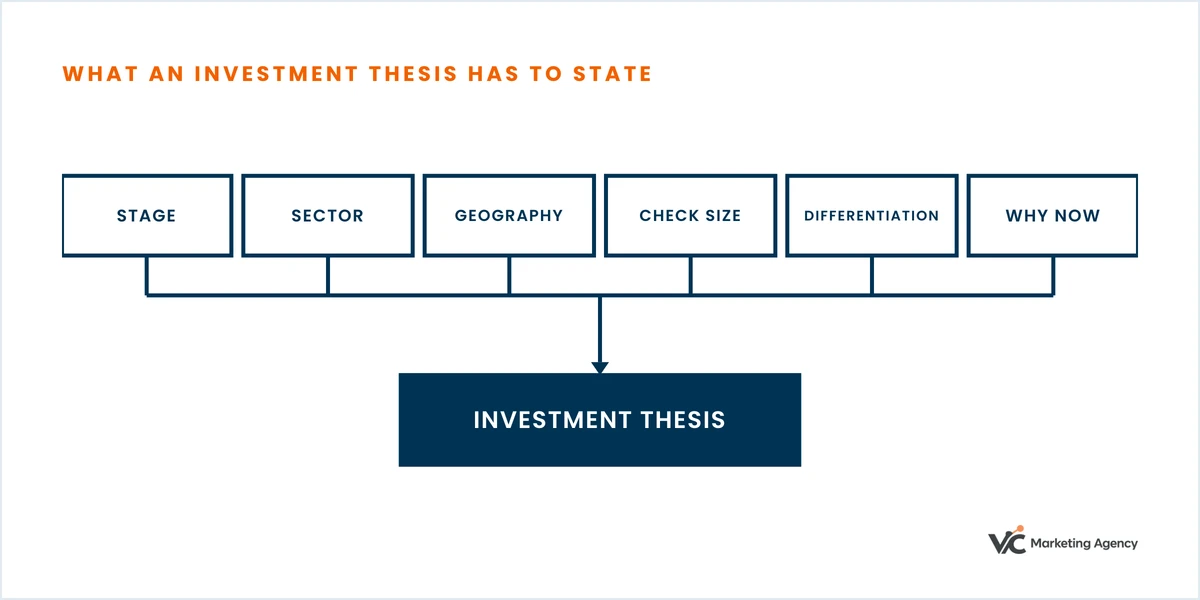
A working thesis is narrow enough to create focus and draw the right deal flow, and wide enough to capture the best opportunities inside those parameters. A thesis might read: “Acme Ventures will write $500K to $2M seed-stage checks in B2B SaaS companies across the Midwest, drawing on our founding team’s 20 years of enterprise sales experience to help portfolio companies scale go-to-market operations.” Naming the stage, sector, geography, check size, and differentiation creates a mandate that governs sourcing, evaluation, and portfolio support.
Step 2 — Register Your Venture Capital Firm with the SEC
Registering a venture capital firm with the SEC establishes an entity that can legally raise capital and invest. Most emerging managers take the Exempt Reporting Adviser (ERA) route under the Investment Advisers Act of 1940, which requires filing basic information on Form ADV without the full obligations of a registered investment adviser.
Two separate exemptions lead to ERA status, and the distinction matters. The venture capital fund adviser exemption under Rule 203(l)-1 applies to an adviser that manages only venture capital funds, and it carries no assets-under-management cap. The private fund adviser exemption under Rule 203(m)-1 applies to advisers managing less than $150 million in private fund assets in the United States, whatever the strategy. An adviser relying on either must file its initial Form ADV within 60 days of claiming the exemption and file annual updating amendments after that, according to the SEC’s final rule “Exemptions for Advisers to Venture Capital Funds, Private Fund Advisers with Less Than $150 Million in Assets Under Management, and Foreign Private Advisers”, Release IA-3222, June 2011.
The fund vehicle is structured to fit exemptions under the Investment Company Act of 1940, usually Section 3(c)(1) or Section 3(c)(7). Section 3(c)(1) permits 100 or fewer beneficial owners, while Section 3(c)(7) allows an unlimited number provided all are qualified purchasers. Capital raising runs as a private offering under Regulation D of the Securities Act of 1933, and most firms form the fund as a Delaware limited partnership.
Step 3 — Raise your first fund from limited partners
Raising a first fund means securing capital commitments from limited partners (LPs), the investors whose money the firm deploys into startups. The main LP types are fund-of-funds, family offices, high-net-worth individuals, and endowments, and first-time managers usually find family offices and high-net-worth individuals more reachable than large institutions.
An anchor LP committing a substantial share of the target fund size accelerates everything that follows, since that commitment signals confidence to other prospective LPs and shortens the path to a first close.
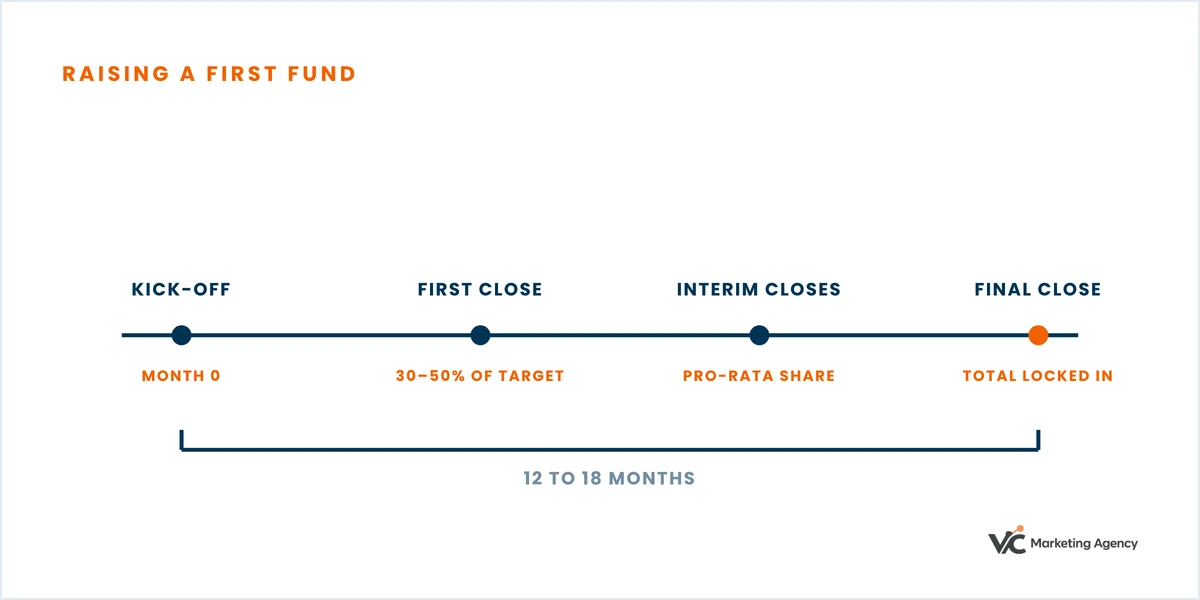
Fundraising runs 12 to 18 months and closes in stages rather than at once. The first close happens when commitments reach roughly 30% to 50% of the target fund size, enough to begin investing, and the final close locks in the total. LPs commit capital rather than transferring cash, and the firm issues capital calls to draw the money down as deals close. The general partner is expected to make a GP commit of 1% to 3% of fund size from personal capital, which aligns the manager with the LPs.
Step 4 — Source and Close Your First Deals
Sourcing and closing first deals starts with a deal-flow pipeline built from personal and professional networks, accelerator relationships, and industry events. A consistent pipeline produces opportunities that match the firm’s investment thesis.
Screening criteria filter that pipeline by stage, sector, geography, and check size. Candidates that clear screening move into due diligence, where the firm evaluates the team, market potential, product differentiation, and financial projections.
Term sheet and deal structuring follow, covering valuation, ownership percentage, and governance rights. In competitive rounds, speed and a reputation for supporting founders decide who wins allocation.
Step 5 — Build your venture capital firm’s back-office operations
Back-office operations handle the legal, financial, and compliance work a fund generates. The infrastructure covers fund administration, banking, legal, tax, and audit.
A fund administrator manages fund accounting, capital-call processing, and investor reporting, coordinating financial statements and maintaining the investor records that keep LPs informed.
Banking partners handle fund transactions and capital deployment, legal counsel covers fund operations and deal structuring, tax advisers manage partnership taxation and filings, and audit partners run the annual audit.
Capital calls require notices to LPs drawing down committed capital, timed and coordinated with banking partners so funds clear before an investment closes. Each closing generates documentation the firm must track and report.
Financial reporting means quarterly updates to LPs covering TVPI, DPI, and IRR. Clear reporting builds the credibility that a second fundraise depends on.
Tax and audit readiness rests on clean records. The firm issues Schedule K-1s to LPs annually and documents every financial activity, which simplifies compliance and supports the firm as it scales.
Step 6 — Support your venture capital firm’s portfolio companies
Supporting portfolio companies raises investment returns beyond what capital alone produces. The forms of active support are listed below:
- Recruiting: introducing portfolio companies to candidates who can fill the roles that determine whether the company scales.
- Customer and investor introductions: connecting startups to potential customers and to investors for later rounds.
- Follow-on funding: holding reserves for follow-on investments, which defends ownership as companies raise again.
- Board seats and strategic guidance: taking board or observer roles that supply direction and governance without interfering in daily operations.
- Concentrated help: applying concentrated effort to the few problems where an investor can change a company’s trajectory.
Step 7 — Establishing your venture capital firm’s investment decision process for future deals
An investment decision process gives the firm a repeatable framework for future deals, which is what makes performance consistent across successive funds.
An investment committee sits at the centre, made up of founding partners and senior investment professionals who evaluate and approve investments. The committee meets weekly or biweekly to review deals that cleared screening, the deal champion presents the thesis, financial model, and diligence findings, and members discuss risks and vote.
A decision framework turns the investment thesis into operating rules, defining screening criteria for stage, sector, and geography, naming the diligence workstreams across product, market, and financials, and setting approval thresholds. Documenting the framework holds the firm consistent as it grows.
A reserve and allocation policy governs how capital is deployed across the fund’s life, usually holding 50% to 60% of total capital for follow-on investments. The policy sets initial check sizes, the conditions for follow-on capital, and maximum ownership concentration in any single company.
What is a venture capital firm?
A venture capital firm is an investment management organization that pools capital from limited partners (LPs) and invests it in high-growth startups and early-stage companies. The firm acts as general partner (GP), making investment decisions, running due diligence, and providing oversight to portfolio companies. Revenue reaches the firm through management fees of around 2% of committed capital annually and carried interest of about 20% of profits after LP capital is returned.
Separating the firm from its funds matters. The firm is the management company that oversees multiple funds, each a separate legal entity formed to pool capital and invest it, and each structured as a limited partnership where the GP controls decisions and LPs supply capital for a share of the gains.
A single venture capital firm usually runs several funds in sequence, Fund I, Fund II, Fund III, each with its own focus and lifecycle, while the firm carries the continuity and brand across all of them.
What does starting a venture capital firm actually involve?
Starting a venture capital firm involves commitments across legal, financial, and operational work at once. The legal structure comes first, usually a limited partnership for the fund and a management company for operations, built to comply with the Investment Advisers Act of 1940.
Fundraising follows, securing commitments from family offices, high-net-worth individuals, and institutional investors, which generally requires a track record credible enough to convince them.
Operations run in parallel. The firm builds a deal-flow pipeline, runs diligence, negotiates term sheets, and closes investments, while standing up back-office infrastructure across fund administration, banking, legal counsel, tax, and audit. Portfolio support adds strategic guidance, follow-on funding, and network access on top.
The horizon stretches past a decade. Management fees of roughly 2% of committed capital cover operating costs during that period, returns take years to materialize, and the manager’s own capital stays locked up for the fund’s duration while a fraction of investments produce most of the outcome.
What is a venture capital firm’s main function?
A venture capital firm’s main function is to raise and manage capital and invest it in startups. The work covers sourcing deals, making investment decisions, and supporting portfolio companies, funded by capital pooled from institutional investors, family offices, and high-net-worth individuals and exchanged for equity in high-growth startups.
The firm carries responsibility across the whole investment lifecycle, running due diligence, negotiating terms, and supplying the support that helps startups scale. The firm manages the fund itself, reporting performance transparently to limited partners, with the aim of producing returns when portfolio companies exit through acquisition or IPO.
What do you need before launching a venture capital firm?
A track record of investments comes first, because limited partners underwrite the manager before the thesis. A record like that can be built through angel investing, syndicate participation, or special purpose vehicles (SPVs), and even first-time managers establish credibility by showing they can find opportunities and produce returns.
A founding team matters next. Solo general partners can launch a firm using technology-driven platforms, though partnering with at least one other experienced investor raises the odds of success, and paired skills across sourcing, evaluation, and portfolio support strengthen both fundraising and deal competitiveness.
A working network completes the picture, spanning limited partners who can commit capital, sources of deal flow, and ties to other investors, advisers, and service providers. Warehoused deals, startups already identified or committed to, show prospective LPs immediate deployment opportunities and prove the manager can reach quality deals in the target market.
How to Become a Venture Capitalist
Becoming a venture capitalist combines education, investing experience, and network building. The steps are listed below:
- Build an educational foundation: most venture capitalists hold degrees in business, finance, or economics, and an MBA supplies both credentials and network access.
- Develop a track record: gain investment experience through angel investing, syndicates, or SPVs, and document the results.
- Gain industry experience: work in roles that expose you to startups and investing, including investment banking, consulting, startup operations, or analyst and associate seats at existing VC firms.
- Build a network: relationships with founders, investors, and limited partners drive deal flow, co-investment, and an eventual fundraise.
- Develop specialized knowledge: focus on a sector, stage, or geography where you can become a known authority and add value to portfolio companies.
- Start small and scale: begin with angel investments or join an angel network to gain experience before raising a fund.
- Consider an established firm first: joining an existing fund teaches the business and builds relationships before you launch your own.
How to manage a venture capital firm
Managing a venture capital firm runs on repeatable operating systems rather than improvisation. The core management areas are listed below:
- Fund administration systems: integrated platforms for administration, financial reporting, and compliance keep operations accurate as the portfolio grows.
- LP communication and reporting: quarterly reports carrying capital account statements and DPI, TVPI, and IRR keep limited partners informed.
- Capital call and closing mechanics: systematic capital calls coordinated with administrators and banking partners draw down committed capital as deals close.
- Tax and audit readiness: working with tax and audit partners maintains compliance, produces annual audited financials, and delivers K-1s to LPs.
- Banking, legal, and service provider relationships: partners who understand fund economics and VC structures reduce friction on every transaction.
- Investment committee processes: a structured decision framework holds evaluation and reserve allocation consistent as the portfolio grows.
- Portfolio support operations: recruiting help, customer and investor introductions, follow-on coordination, and board governance delivered systematically.
- Fund performance and economics: tracking how the 2% management fee funds operations while positioning the firm to earn its 20% carried interest.
- Fund lifecycle milestones: planning for tax season, annual audits, LP annual meetings, and the transition toward a follow-on fund.
- Technology to reduce operational burden: fund administration technology streamlines the back office, which matters most for solo GPs and small teams.
How much capital does a venture capital firm need to launch?
A venture capital firm launches on $10 million to $50 million in committed capital. Emerging-manager market data from SetOne Labs puts the median US venture fund at $25.0 million in 2025, with first-time funds clustering lower and generally closing between $15 million and $40 million after 12 to 18 months of fundraising.
Minimum viable fund size and the operating budget drive the requirement, since the management fee funds operations. A narrow thesis and a lean team can work on a smaller fund, while broader mandates and wider portfolios need more capital.
The market has moved toward smaller, specialist funds. The median US venture fund fell to $15.3 million in the first quarter of 2026, and 2025 produced $7.3 billion across 106 first-time US venture funds against $24.3 billion across 461 funds in 2021. US venture fundraising closed $66.1 billion in total across 537 funds in 2025, its weakest total since 2018, according to the Q4 2025 PitchBook-NVCA Venture Monitor. The wider funding, deal-volume and fund-performance picture those numbers sit inside is set out in venture capital statistics.
How to raise funds for a venture capital firm
Raising a venture fund is a structured campaign rather than a series of meetings. The steps are listed below:
- Develop a compelling investment thesis: state target sectors, stage focus, and geography so LPs can place your fund against others.
- Identify and approach potential LPs: build a list across fund-of-funds, family offices, high-net-worth individuals, and endowments, and shape the approach to each type.
- Secure an anchor LP: a reputable anchor commitment lends credibility and momentum to everything after it.
- Prepare fundraising materials: a pitch deck, strategy memo, and legal documents carry the fund’s thesis and terms.
- Conduct warm introductions: venture fundraising is relationship-driven, and warm paths to LPs convert far better than cold ones.
- Execute a first close: closing at 50% to 60% of target lets the firm start deploying while it continues raising.
- Maintain ongoing communication: updating LPs on pipeline and early wins builds the trust that produces further commitments.
- Call capital as needed: issue capital calls as investments close, drawing only what named deals and expenses require.
What are the legal requirements for a venture capital firm?
The legal requirements for a venture capital firm centre on the limited partnership structure, which protects limited partners from liability while leaving management control with the general partner. The limited partnership agreement (LPA) governs terms between GP and LPs, covering fees, investment strategy, and governance rights.
Two further entities complete the structure. A management company, usually an LLC, runs daily operations and collects management fees, while a separate general partner entity holds the carried interest and makes investment decisions for the fund. Most funds register as Delaware limited partnerships for the flexibility of Delaware’s statutes.
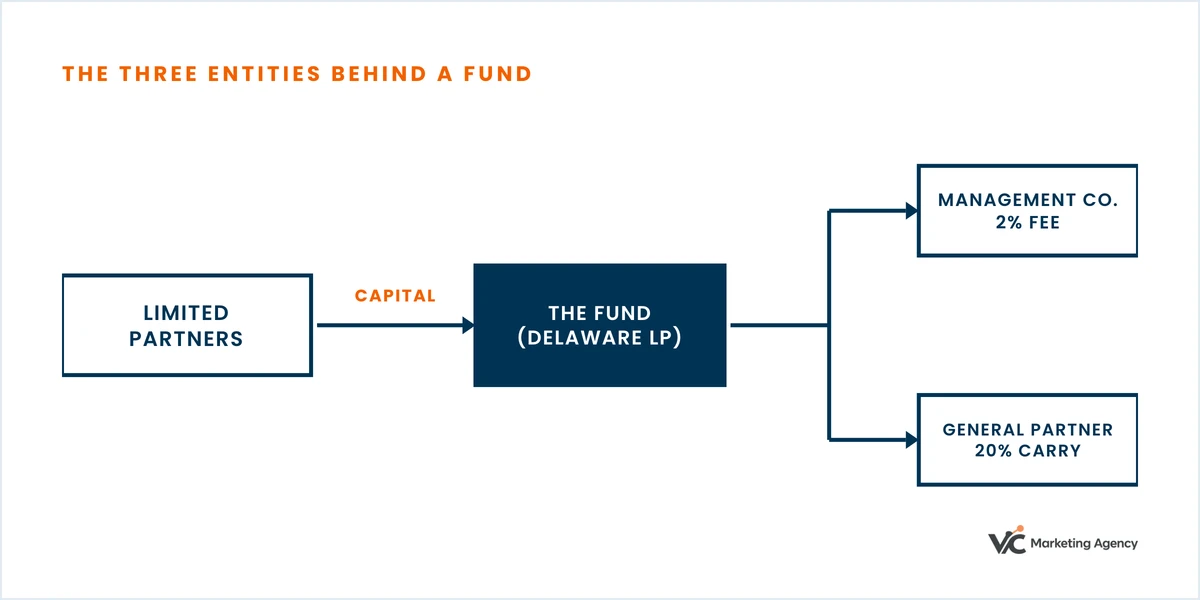
Adviser registration sits on top of the structure. Emerging managers generally file as Exempt Reporting Advisers under the Investment Advisers Act of 1940, relying either on the venture capital fund adviser exemption of Rule 203(l)-1, which has no AUM cap for advisers to venture funds only, or on the private fund adviser exemption of Rule 203(m)-1 for advisers under $150 million, both defined by the SEC under the Investment Advisers Act of 1940. Alternative structures include special purpose vehicles and rolling funds.
What team roles does a new venture capital firm need?
A new venture capital firm needs a small team covering investment and operations. The core roles are listed below:
- General partner or managing partner: leads investment strategy, makes final decisions, and owns the limited partner relationships.
- Principal: runs due diligence and leads individual deals.
- Associate: sources deals, conducts initial diligence, and supports the investment team.
- Platform or value-add roles: handle portfolio support across talent, marketing, and business development.
- Outsourced back office: covers fund administration, accounting, compliance, and reporting so the core team stays on investing.
What types of venture capital firms can you launch?
The type of venture capital firm you launch follows from your investment thesis, available capital, and network. The main types are listed below:
| Firm Type | Typical Fund Size | Stage Focus | Sector Mandate | Primary LP Base |
|---|---|---|---|---|
| Micro / Nano VC | Under $50M | Pre-seed, Seed | Highly focused, vertical or geography-led | High-net-worth individuals, family offices, specialized seed LPs |
| Seed / Early-Stage | $10M–$50M | Pre-seed, Seed, Series A | Sector-focused or generalist | Family offices, HNWIs, fund-of-funds, endowments |
| Multi-Stage / Generalist | $50M–$500M+ | Seed through Growth | Broad or lightly thematic | Institutional LPs, fund-of-funds, endowments, pensions |
| Corporate VC | Around $50M or less | Varies by parent strategy | Strategic alignment with parent company | Parent company, strategic budgets, occasional outside co-investors |
| Sector-Specialist | Varies widely | Seed through Series B | One sector, such as fintech or healthtech | Specialist LPs, family offices, fund-of-funds, strategic investors |
Micro VC Firms
Micro VC firms manage funds under $50 million and concentrate on pre-seed and seed-stage investments, writing checks from $250,000 to $2 million per deal. A narrow investment thesis defines them, targeting a sector, geography, or founder demographic tightly enough to build domain command and a strong network inside that niche.
Solo general partners or small teams run most micro VC firms, which produces fast decisions and close relationships with early-stage founders. Platforms such as AngelList’s Rolling Funds lowered the administrative and operating cost of launching one, which is why the category has grown.
Corporate Venture Capital Firms
Corporate venture capital (CVC) firms are investment arms of larger corporations built to serve strategic and financial goals together. CVCs align their investments with the parent company’s business, backing startups whose technology or market position complements it, and they bring the corporation’s industry knowledge and customer networks to portfolio companies.
The dual mandate cuts both ways. CVCs pursue financial returns alongside strategic benefits such as access to new technology, entry into new markets, or partnerships, and investments must clear both tests, which slows decisions. Structures vary: some CVCs operate as independent entities with their own funds, while others sit inside corporate development and invest directly off the parent’s balance sheet.
How to Grow a Venture Capital Firm Portfolio
Growing a venture capital firm’s portfolio runs on four levers. The growth levers are listed below:
- Deal flow: networking, industry events, and referrals produce the opportunities that match the firm’s thesis.
- Portfolio value-add: strategic guidance, customer and investor introductions, and recruiting help drive company growth.
- Follow-on reserves: reserves let the firm support winners in later rounds and hold ownership as they scale.
- Marketing for LP acquisition and brand authority: thought leadership and content build visibility with LPs and founders alike.
What is the importance of marketing for Venture capital firm growth?
The importance of marketing for venture capital firm growth is that it drives limited partner acquisition, brand authority, and deal flow at the same time. A firm that publishes consistently establishes itself as an authority, which raises its visibility and credibility in a crowded market.
Visibility makes the firm’s investment thesis memorable to founders, co-investors, and prospective LPs. Better recall produces better access to high-quality investment opportunities and a shorter path to raising the next fund.
Why choosing the right Venture capital marketing agency is important for venture capital growth?
Choosing the right venture capital marketing agency shapes how fast a firm grows. A specialist partner strengthens limited partner acquisition and brand authority by building strategies calibrated to institutional investors rather than general B2B audiences.
Venture Capital Marketing Agency focuses on LP acquisition, founder attraction, and portfolio support, which turns marketing into a repeatable growth engine. Working with an agency that knows the venture capital sector gives a firm an edge in a competitive market and sustains visibility across fundraising cycles.
What are the risks involved in starting a venture capital firm?
Starting a venture capital firm carries risks that determine whether a first fund becomes a franchise or a single vehicle. The main risks are listed below:
- Ten-year illiquidity and capital lock-up: venture funds run roughly ten years, and capital stays locked and illiquid across that period for managers and LPs alike.
- Power-law returns and concentration risk: a small number of investments generate the majority of returns while most portfolio companies fail or return little, so reaching the outliers decides fund performance. Research by Shikhar Ghosh of Harvard Business School, covering 2,000 venture-backed companies funded between 2004 and 2010, found 75% never returned cash to investors, and a Correlation Ventures study of more than 27,000 investments from 2009 to 2018 put the share of deals failing to return original principal at 64%.
- The J-curve and cash flow: management fees and early investment costs produce negative returns in a fund’s early years, and meaningful returns take years to arrive.
- Surviving to Fund II: a second fund depends on the first, and managers without realized gains struggle to raise again.
- Personal financial and opportunity cost: the GP commit ties up personal capital, and leaving a stable, high-paying role carries its own cost if the fund underperforms.
- Regulatory and compliance risk: obligations under the Investment Advisers Act of 1940 are complex, and failures bring penalties and reputational damage.
- Market timing and vintage year risk: vintage year shapes fund performance and managers control it only loosely.
- Relationship and reputational risk: weak investment decisions or poor LP communication damage relationships and block future fundraising.
- The honest reality: venture capital is competitive, and only a small share of managers produce returns that justify the risk, which makes joining an established firm the better path for many professionals.
What is the benefit of starting a venture capital firm?
Starting a venture capital firm produces financial and strategic benefits. The financial model is 2-and-20, a 2% management fee on committed capital plus 20% carried interest on gains. Management fees cover operating costs and salaries while carried interest delivers a share of exit profits, so a $100 million fund generates $2 million annually in fees with the potential for $20 million in carry if the fund performs.
The strategic benefits build over time. Fund managers gain access to startups, founders, and co-investors, which strengthens their ability to win competitive deals, and the firm’s brand attracts both high-quality entrepreneurs and future limited partners.
Those benefits reach managers who deliver returns and raise follow-on funds. The network compounds into an asset that feeds deal flow, recruiting, and portfolio support, and reaching that point takes a decade of consistent execution.
What is the return on investment for a venture capital firm?
The return on investment for a venture capital firm runs through the 2-and-20 model, a 2% management fee on committed capital plus 20% carried interest on profits after LP capital is returned. DPI, TVPI, and IRR measure whether the model is working.
A mature venture fund targets net IRR above 20% and TVPI of 2.0x to 3.0x or higher. Top-quartile funds reach 20% to 35% IRR and TVPI at or above 3.0x, while median funds land closer to 12% to 15% net IRR and 1.5x to 1.8x TVPI, according to Cambridge Associates US venture capital benchmark data.
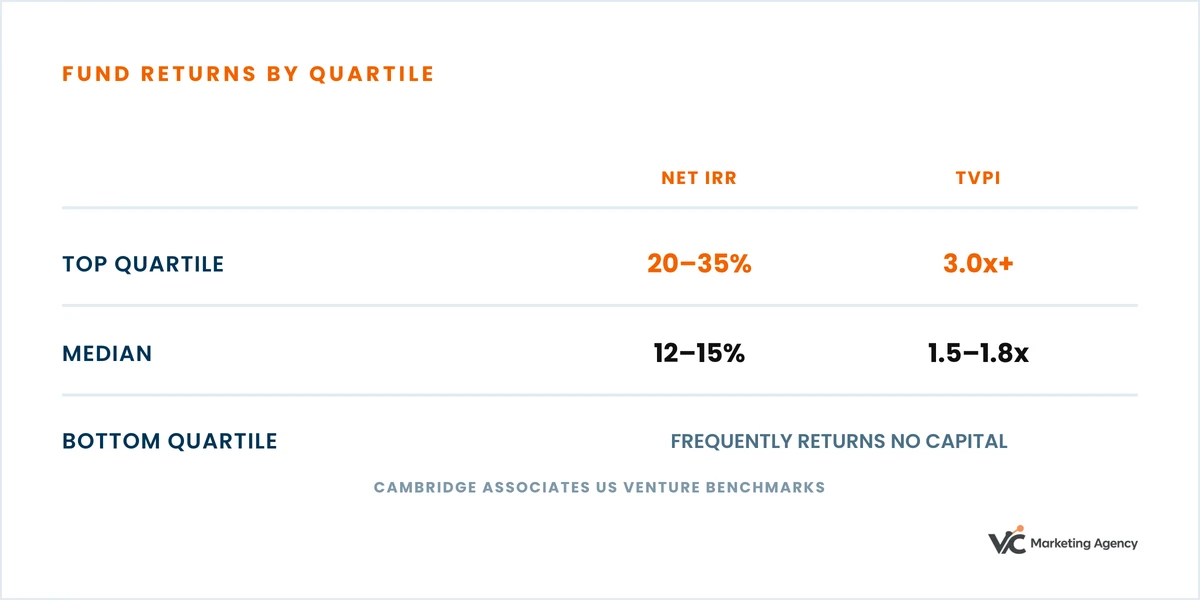
Realized cash separates a strong fund from a well-marked one. Bottom-quartile funds frequently fail to return capital at all, which is why DPI matters alongside TVPI and IRR when LPs assess whether a manager deserves a second fund.
How do you turn venture capital fund management into a sustainable firm?
Turning fund management into a sustainable firm rests on three pillars: a credible track record, disciplined LP reporting, and the ability to raise follow-on funds. A track record demonstrates consistent returns and attracts repeat commitments, while disciplined reporting through DPI, TVPI, and IRR builds the trust those commitments depend on.
Raising follow-on funds is what proves longevity, showing the firm can hold existing LP relationships while attracting new investors. Treating each fund as part of a long-term partnership rather than a standalone vehicle is what marks a firm as a franchise instead of a project.
Sustainability further requires operational infrastructure that survives market cycles, built on repeatable processes for sourcing, diligence, and portfolio support. A firm operating that way compounds its capital, relationships, and influence across successive funds.
How do venture capital firms report performance to limited partners?
Venture capital firms report performance to limited partners through quarterly updates carrying capital account statements and performance metrics. DPI measures cash actually returned to investors, TVPI combines realized and unrealized portfolio value, and IRR gives the annualized return on invested capital.
Quarterly reporting gives limited partners a view of both realized returns and the valuation of holdings still in the portfolio. Accuracy and transparency in those reports build the trust that governs future fund commitments, and the strength of the reported track record determines whether a firm can raise again.
How does a venture capital firm raise a follow-on fund?
A venture capital firm raises a follow-on fund on the performance of Fund I, led by DPI, which shows the cash actually returned to limited partners. Existing LPs form the core of the new investor base through re-ups, since they already have evidence the manager can produce returns.
TVPI and IRR complete the case, covering realized and unrealized gains together and validating both investment selection and portfolio support. Quarterly reports and capital account statements build confidence among new investors such as institutional LPs, family offices, and fund-of-funds.
Moving from a single fund to sequential funds is what turns fund management into an enduring firm, establishing a recurring revenue base and compounding the firm’s brand across vintages.