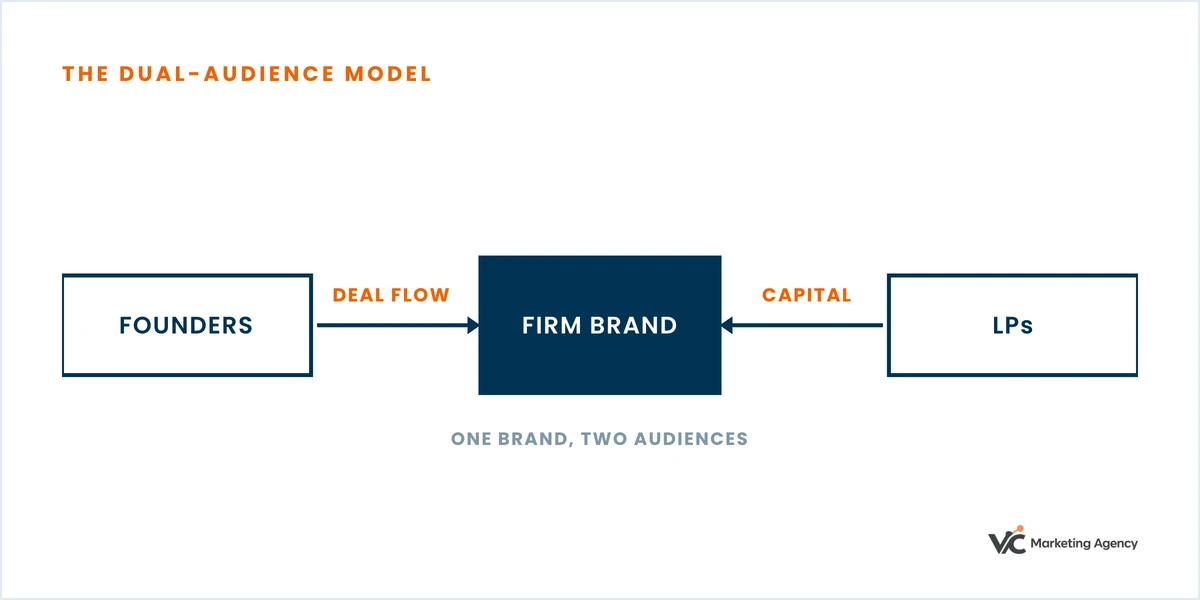
Venture capital marketing is the strategic practice VC firms use to build a differentiated brand in a saturated market. Venture capital marketing addresses two audiences at once: founders who supply quality deal flow, and limited partners (LPs) who supply capital for the next fund. Each audience demands separate messaging, since founders weigh strategic guidance and sector knowledge while LPs weigh transparency and proven results.
Marketing strategies that establish firm authority include content marketing, thought leadership, and brand positioning. Content marketing produces blogs, podcasts, newsletters, whitepapers, and webinars that demonstrate a firm’s command of its sectors. Thought leadership carries a published investment thesis and sector commentary. Brand positioning builds a narrative around the firm’s culture and values, held together by a consistent visual and verbal identity.
Digital channels distribute that authority. SEO secures visibility through founder and LP keyword research, answer-engine optimization, and YouTube SEO, while paid search and retargeting reach LPs around events and fundraising windows. Social media on LinkedIn and X/Twitter amplifies partner voices and sustains community engagement. Firms then measure results through KPIs, attribution, and ROI, resource the work through tools and either an internal team or an agency, and assemble the components into a venture capital marketing plan. Avoiding the common mistakes that undermine those efforts starts with a precise definition of venture capital marketing.
What Is Venture Capital Marketing?
Venture capital marketing is the strategic practice VC firms use to build a differentiated brand in a saturated market. Venture capital marketing works as a strategic pillar rather than a support activity, presenting the firm’s brand, investment thesis, and value proposition instead of individual deals. The dual goal is high-quality deal flow from founders and capital commitments from limited partners (LPs).
Market saturation is why the discipline exists. Capital alone stopped differentiating firms once thousands of them began competing for the same founders and the same LP allocations. The US venture capital industry closed 2023 with 3,417 active firms holding $1.21 trillion in assets under management, according to the 2024 NVCA Yearbook, compiled with PitchBook.
Differentiation and brand equity now decide which firms grow. Venture capital marketing builds a firm’s authority, visibility, and trust across founder and LP audiences at the same time, converting brand strength into deal flow and LP confidence.
How Does Venture Capital Marketing Work?
Venture capital marketing works through a dual-audience funnel aimed at quality founders and limited partners (LPs). Founder-facing marketing raises visibility and credibility and positions the firm as a preferred investment partner. LP-facing marketing presents track record, a disciplined investment thesis, and transparent portfolio performance. Founders respond to operational support and sector knowledge, while LPs weigh risk-adjusted returns and governance.
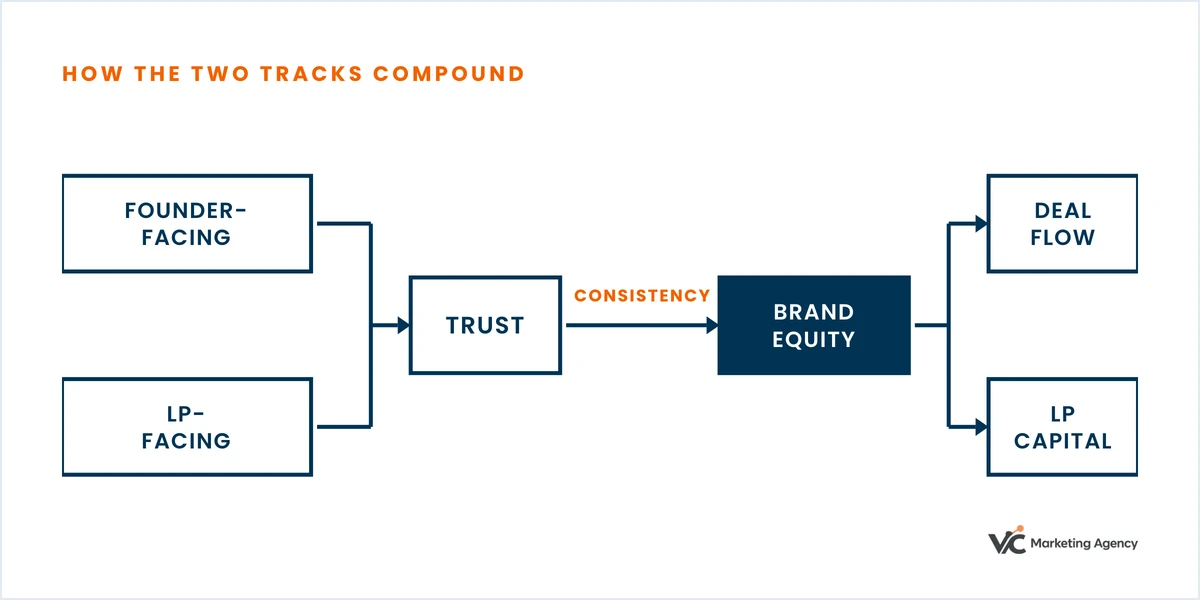
Trust sits at the centre of both tracks. Consistent thought leadership, transparent communication, and demonstrated command of target sectors build that trust over time.
The portfolio-company amplification loop reinforces credibility further, presenting successful portfolio companies as proof of the firm’s value. Founder networks spread the firm’s reputation and generate referrals, while regular updates on portfolio wins and market analysis deepen LP relations.
The two-audience model turns marketing into a growth engine. Firms that maintain discipline and consistency convert visibility and credibility into brand equity, and brand equity produces better deal flow and stronger LP capital. Both feed the same machine, and how venture capital firms work sets out where deal flow and LP commitments enter the fund cycle.
How Can Venture Capital Firms Grow Their Brand Through Marketing?
Venture capital firms grow their brand through marketing by building authority and visibility among founders and limited partners (LPs) at a consistent pace. Firms demonstrate differentiated knowledge by publishing clear investment theses and sector analysis. Partners who sustain that output become credible voices in named verticals and stay top-of-mind for quality founders and LPs weighing opportunities.
Brand growth rests on separating from competing firms in a saturated market. Firms that articulate a distinct narrative and hold a recognizable visual and verbal identity stand apart from the field. Publicizing portfolio companies’ success stories strengthens brand equity further and marks the firm as a specialist rather than a generalist.
What are the most effective Marketing Strategy for VC Firms?
The most effective marketing strategies for venture capital firms are listed below:
- Content marketing: creating and distributing blogs, newsletters, podcasts, whitepapers, and webinars that demonstrate sector command and engage both founders and limited partners (LPs).
- Thought leadership: positioning the firm and its partners as industry authorities through published investment theses, market commentary, and participation in industry discussions and events.
- Brand positioning: defining the firm’s voice, values, and narrative, and aligning that identity with its target audiences to build lasting brand equity and trust.
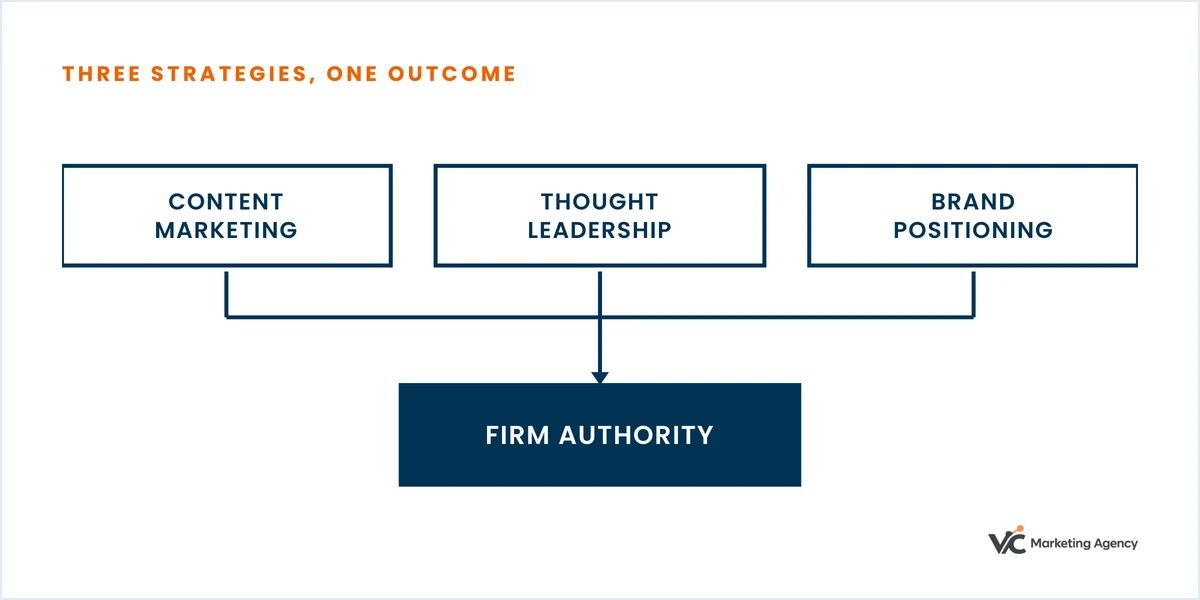
Together those three strategies raise visibility, credibility, and sustained engagement with the stakeholders who decide a firm’s growth.
Content Marketing Strategy for VC Firms
A content marketing strategy for VC firms produces and distributes material that demonstrates sector command and attracts founders and limited partners (LPs). The format mix spans blogs, podcasts, newsletters, whitepapers, and video or webinars, and each format carries a distinct job: blogs supply in-depth analysis and support SEO, podcasts host conversations with industry leaders, newsletters curate market reading, whitepapers present data-driven market intelligence, and video delivers visual storytelling.
An editorial calendar anchors the strategy, holding a consistent publishing cadence that balances timely market commentary against evergreen thought leadership. Repurposing extends reach, turning a single piece of research into several formats across channels.
Measurement runs on SMART objectives (Specific, Measurable, Achievable, Relevant, Time-bound), tracking engagement metrics alongside business outcomes such as inbound deal quality and LP engagement rates. Distribution reaches founders through LinkedIn, newsletters, and industry blogs, while LPs engage through email, proprietary reports, and conference presentations. Content tied directly to the firm’s investment thesis outperforms generic advice and positions the firm as the partner of choice in named verticals.
Thought Leadership for Venture Capital Partners
Thought leadership for venture capital partners establishes authority through a published investment thesis and sector analysis. A partner who consistently shares a clear perspective on emerging trends, market direction, and investment opportunities builds a personal brand that attracts founders and earns LP trust.
Thought leadership takes shape through published articles, interviews, and conference talks that carry the firm’s investment thesis and market commentary outward. Partners who express sharp, repeatable views tied to the sectors and stages the firm supports separate their voice from a crowded field and strengthen both deal flow and LP relations.
Brand Positioning and Identity for VC Firms
Brand positioning and identity for VC firms define how a firm differentiates itself in a crowded market. Positioning work produces a narrative that reflects the firm’s culture and values. Brand identity expresses that narrative through visual signals such as logo and typography and through verbal identity such as the firm’s voice and positioning statement, so founders and limited partners (LPs) can read the firm’s value proposition and investment philosophy directly.
Successful VC branding moves from a reputation-driven model to a strategic, public-facing one built on clear communication of the thesis and consistent messaging. Benchmark and Root Ventures show how visual identity signals investment philosophy, with Benchmark’s minimalist approach and Root Ventures’ technical aesthetic. Once positioning is set, digital channels carry the brand narrative to its audiences.
What are the most effective Digital Marketing Channels for VC Firms?
The most effective digital marketing channels for venture capital firms are listed below:
- SEO (search engine optimization): improves a firm’s visibility in search results so founders and LPs can find its investment thesis and sector coverage, and supports long-term discoverability including answer-engine visibility.
- Paid search and retargeting: reaches high-intent audiences at decisive moments such as fundraising cycles or post-event follow-up, keeping the firm visible to people who already engaged with its content.
- Social media: extends thought leadership on LinkedIn and X/Twitter, amplifies partner voices, and sustains engagement with founders and LPs in public channels.
SEO marketing for Venture Capital Firm Website
SEO marketing for a venture capital firm website improves discoverability in search results. The work starts with keyword research across both audiences, since founders search funding terms tied to their sector while limited partners (LPs) search performance indicators and thesis validation.
Answer-engine optimization (AEO) and generative-engine optimization (GEO) place a firm’s content inside AI-powered search tools, which requires structured data markup and conversational content formats. YouTube SEO extends the same visibility to video, where a firm’s commentary reaches audiences across web and video platforms. Each tactic ties the firm’s online presence to its investment thesis and reinforces brand authority.
Paid Search and Retargeting for VC Firms
Paid search and retargeting reach high-intent audiences at decisive moments in a venture capital firm’s calendar. Paid search campaigns capture interest around named topics or the firm’s own name, holding visibility when investors and founders search related terms. Retargeting reaches audiences who already engaged with the firm, including website visitors and event participants.
LP retargeting serves ads to investors who engaged with the firm’s content, keeping the firm present through fundraising cycles that can run 12 to 18 months. Targeting LPs who already showed interest sustains engagement and builds trust across that window.
Event and fundraise campaigns use paid search to drive awareness around fund launches and industry conferences, holding the firm in view of investors actively researching opportunities. Retargeting extends that visibility and reminds attendees of the firm’s focus after the event closes.
Paid channels complement organic marketing by supplying faster distribution and controlled targeting. Firms reach further when timing matters, as during a capital-raise window or a major announcement, and pairing paid media with strong organic positioning sustains visibility with both audiences.
Social Media Strategy for Venture Capital Firms
A social media strategy for venture capital firms builds brand authority and engages founders and limited partners (LPs). The strategy prioritizes LinkedIn as the primary channel, supported by X/Twitter and partner personal branding. The components are listed below:
- LinkedIn priority: the main platform for professional engagement, carrying founder-facing analysis, portfolio wins, and thesis-driven posts that turn sector command into durable visibility.
- X/Twitter: real-time market commentary, startup discovery, and networking inside the tech community, supporting rapid-response dialogue and live event coverage.
- Partner amplification: individual partners extend the firm’s reach through personal brands, since market commentary published under a personal account carries more trust and reach than a corporate account.
- Community engagement: participation in sector discussions and direct responses to founders keep the firm visible in relevant conversations, above all when the firm shares useful analysis rather than promotional updates.
Firms measure social activity through engagement quality, referral traffic, and inbound interest, and link those measures back to marketing KPIs and attribution.
How to Measure Venture Capital Marketing Success with KPIs and ROI
Venture capital firms measure marketing success by tracking metrics that capture both immediate outcomes and long-term relationship building. Core metrics cover inbound deal quality, LP engagement, brand awareness, and attribution. Inbound deal quality measures the volume and conversion rate of founder inquiries, LP engagement measures newsletter open rates, event attendance, and fundraising conversation velocity, and brand awareness measures media mentions, search visibility, and share of voice in target sectors.
Attribution models connect marketing activity to outcomes, linking content downloads, event touchpoints, or retargeting campaigns to portfolio investments and LP commitments. Benchmarking against industry standards puts those numbers in context, comparing media mentions, content engagement rates, and deal flow quality across firms of similar stage, fund size, and target audience. Gartner’s 2025 CMO Spend Survey, which polled 402 marketing leaders across North America and Europe, found marketing budgets flat at 7.7% of company revenue for a second consecutive year, giving firms a cross-industry reference point for what they commit.
The measurement horizon in venture capital marketing runs longer than a standard B2B cycle. Leading indicators such as website traffic, content downloads, and event registrations balance against lagging indicators such as deal flow quality and investment close rates. Reading both together shows marketing ROI and points to the strategies that move each audience closer to partnership, and the KPIs defined here determine which tools a firm needs to track them.
What are the Tools for Measuring Success in Venture Capital Marketing?
The tools for measuring success in venture capital marketing fall into three categories, listed below:
- Analytics platforms: tools such as Google Analytics monitor website traffic, content engagement, and user behaviour, tracking page views, time on site, and conversion paths to show which content reaches founders and limited partners (LPs).
- CRM systems: customer relationship management systems manage interactions with founders and LPs, recording touchpoints, meeting notes, and engagement history, and attributing inbound opportunities to named marketing activity.
- Attribution platforms: attribution tools connect marketing activity to business outcomes, identifying which channels, campaigns, or content pieces generate qualified deal flow or LP interest, and linking spend to measurable results such as pitch requests and event registrations.
When to Build an Internal VC Marketing Function?
A venture capital firm builds an internal marketing function once marketing becomes a continuous strategic requirement rather than a set of sporadic campaigns. The shift usually arrives while a firm raises a third or subsequent fund, when brand strength starts deciding which deals and which LP commitments the firm wins.
Several signals reinforce the decision: a steady flow of deals that needs nurturing, multiple LP engagements each year, a portfolio large enough to require coordinated storytelling, and partners without the bandwidth to run marketing themselves.
Firms usually start with a single platform function or a marketing lead reporting to a managing partner, which holds execution consistent across channels and communications before any larger team is built.
What are the key components of a venture capital marketing plan?
A venture capital marketing plan is a structured approach to building brand authority, attracting deal flow, and holding the attention of limited partners. The components are listed below:
Objectives and goals. The plan defines measurable objectives aligned to the firm’s strategic priorities, such as increasing inbound deal flow, improving LP engagement, raising brand awareness, or supporting an upcoming fundraise. Objectives follow the SMART framework (Specific, Measurable, Achievable, Relevant, Time-bound).
Audience definition. The plan segments the two core audiences. For founders it identifies target profiles, stage preferences, sector focus, and geographic reach. For LPs it defines investor types, investment capacity thresholds, and communication preferences, with messaging calibrated to each.
Strategy and channel mix. The plan sets out content marketing, thought leadership, brand positioning, and digital channels, prioritizing LinkedIn for professional engagement, SEO for discoverability, and paid search for time-bound campaigns.
Budget and resourcing. The plan allocates spend across content production, paid media, event participation, and personnel, and settles the choice between an internal marketing function and a specialized agency.
Measurement framework. The plan names the KPIs that track success, including inbound deal quality, LP engagement rates, brand awareness, website traffic, content performance, and social reach, and specifies the attribution models that connect activity to outcomes.
SEC and Regulation D compliance. Because securities marketing is regulated, the plan carries compliance guardrails covering legal review of content, disclaimers, recordkeeping, and rules for communicating fund performance.
Resourcing decisions inside the plan lead directly to the question of whether a firm should build those capabilities internally or engage a specialized agency.
When to Hire a Venture Capital Marketing Agency?
A venture capital firm hires a marketing agency when execution demands exceed internal capability. The common triggers are limited internal headcount, a brand launch on a compressed timeline, and the need for compliance-aware marketing in a regulated sector.
Agencies supply brand strategy, public relations, content production, SEO, paid media, and lead generation. Firms engage them on retainer for ongoing support or per project for defined initiatives, which frees partners to concentrate on deal sourcing and investor relations.
Why Hire VC (Venture Capital Marketing) Agency?
Venture capital firms hire a Venture capital marketing agency for execution they cannot staff internally at the same speed. Agencies move faster across brand development, content production, SEO, and paid media, which returns partner time to deal sourcing and fundraising.
Agencies work within regulatory constraints such as SEC compliance and Regulation D, keeping campaigns aligned with the rules that govern securities marketing. Firms that outsource those functions gain proven frameworks and established channels and accelerate brand and fundraising work without diverting partners from strategy.
What are the pros of Hiring a Venture Capital Marketing Agency?
The advantages of hiring a venture capital marketing agency are listed below:
- Vertical knowledge: specialized agencies understand venture capital and financial services well enough to write messaging that reaches founders and limited partners.
- Speed and scale of execution: established processes and staffed teams deploy campaigns across several channels at once, compressing time to market.
- Access to specialized channels: agencies bring experience with founder content, LP communications, and AI-powered search tools, widening a firm’s reach.
- Measurement rigour: agencies install analytics frameworks that track marketing performance and ROI precisely, which sharpens budget allocation.
- Compliance familiarity: agencies work to SEC and Regulation D requirements, keeping marketing materials within legal standards and reducing regulatory risk.
- Scalability: agency support flexes as a firm grows, enters new sectors, or increases content output, without immediate full-time hiring.
- Partner time savings: handing day-to-day marketing to an agency returns partner hours to deal sourcing and fundraising.
- Strategic outside perspective: an external view refines a firm’s positioning and communication and sharpens its market presence.
- Cost flexibility: one engagement covers several marketing functions, which costs a smaller firm less than building an internal team.
What are the most common VC Marketing Mistakes to Avoid?
Venture capital marketing rewards planning and consistency, and a handful of recurring errors undermine both. The most common VC marketing mistakes are listed below:
- Treating marketing as a short-term activity: firms that market only around fundraising cycles or events never accumulate brand equity or trust, because venture capital marketing compounds through continuous work.
- Ignoring SEC and Regulation D compliance: marketing materials must carry truthful statements and required disclosures, and firms that fall outside the rules face legal consequences and reputational damage. The U.S. Securities and Exchange Commission permits general solicitation under Rule 506(c) only when every purchaser is an accredited investor and the issuer takes reasonable steps to verify that status.
- Running no measurement or attribution: without KPIs and attribution models a firm cannot tell which strategies produce quality deal flow or LP engagement, which makes marketing spend impossible to optimize.
- Publishing generic content disconnected from the investment thesis: content that carries no distinct perspective or sector focus builds no authority, while content tied to the firm’s thesis demonstrates sector command.
- Neglecting the LP audience: founder-facing marketing draws attention, and LP engagement sustains the fund, so firms need messaging calibrated to both.
Avoiding those errors keeps venture capital marketing working as a strategic pillar that supplies deal flow and strengthens LP confidence.