Venture capital firms work by raising money from outside investors, investing it in high-growth startups in exchange for equity, helping those companies scale, and earning profit when they exit through an acquisition or IPO. This article explains how that model works from end to end: what a venture capital firm is and how it’s structured internally, how it raises capital from limited partners, how it evaluates startups through screening, due diligence, and term sheets, the funding stages it invests across from pre-seed to late-stage, how it manages and supports its portfolio companies, and finally how it generates profit through management fees, carried interest, and exits.
What is a venture capital firm?
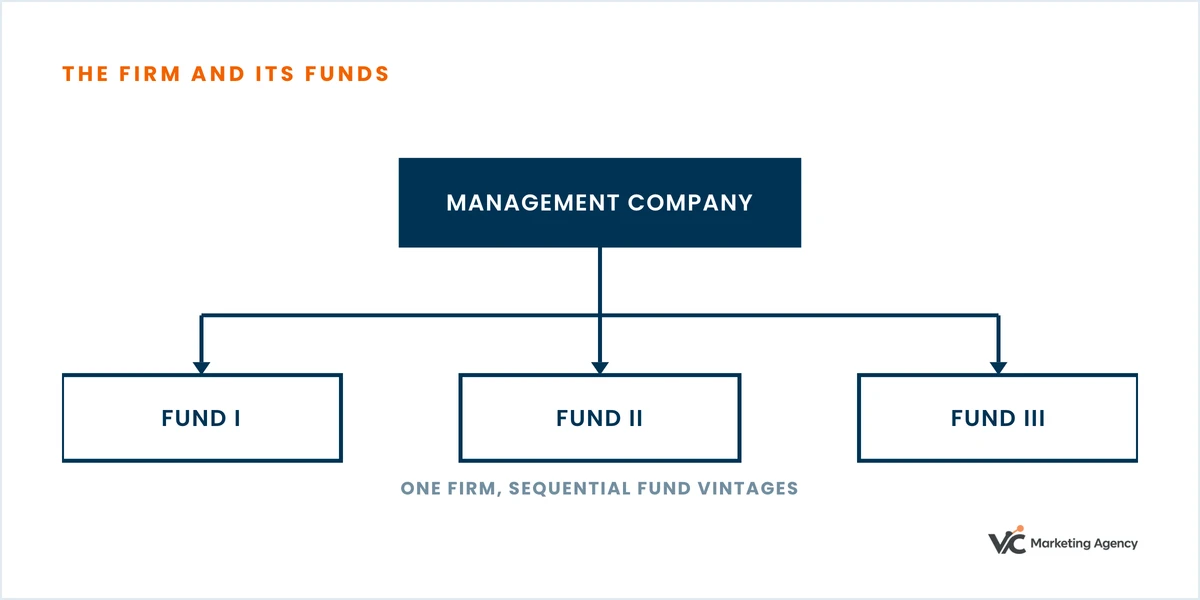
A venture capital firm is a professional investment management company that raises pooled capital from institutional and individual investors and deploys it into early-stage, high-growth startups in exchange for equity ownership. The firm and its funds are separate entities: the firm is the management company employing the general partners, principals, and associates who source deals and decide where capital goes, while each fund is a distinct limited partnership with a fixed size, term, and set of investors. One firm raises several funds across its lifetime, numbered sequentially as Fund I, Fund II, and Fund III, and persists as the operating entity across those generations.
Two features shape everything that follows. Venture capital exchanges capital for ownership rather than issuing debt, so the firm’s return tracks the company’s growth and eventual exit instead of a fixed repayment schedule, and equity carries voting rights and board influence with it. Early-stage failure rates are also high, so a firm expects most positions to underperform while a small number of breakout companies carry the fund’s total return, which concentrates venture money in fast-scaling technology and life-sciences sectors. The fundamentals behind that model are set out in venture capital, including how it differs from angel investing and private equity.
How is a venture capital firm structured internally?
A venture capital firm operates on a two-tier partnership structure that splits authority between general partners and limited partners. General partners direct investment decisions, source deal flow, negotiate terms, and carry fiduciary and legal responsibility for the fund’s performance. Limited partners (pension funds, endowments, and other institutional investors) supply most of the committed capital, hold no role in day-to-day deal selection, and limit their financial exposure to the capital they have pledged.
Within the general-partner side, the investment team follows a partner-principal-associate hierarchy that assigns responsibility by seniority. Associates source deal flow and screen early-stage opportunities, principals lead due diligence and commonly take board-observer seats on companies under review, and partners hold final investment authority, occupy portfolio company board seats, and manage relationships with limited partners. Managing partners sit at the top of the hierarchy, setting fund strategy and approving the largest commitments.
Legally, a venture capital firm separates the management company from the fund the management company operates. The management company employs the investment team and funds salaries and operating costs through the management fee, while each fund exists as a distinct limited partnership holding committed capital and portfolio equity, with the general-partner entity serving as general partner. Separating the two entities lets one management company raise and run multiple fund vintages in parallel. Fee economics follow the industry-standard “2 and 20” model: a 2% annual management fee covers firm operations, and 20% carried interest rewards general partners once limited partners recover their invested capital. The National Venture Capital Association’s model fund documents establish these terms as the standard benchmark for venture fund fee structures.
How long is the typical lifecycle of a venture capital fund?
A venture capital fund normally operates on a ten-year closed-end term, with general partners able to extend the period by one to two additional years to complete remaining exits, a structure the National Venture Capital Association’s model fund documents set as the standard term for institutional venture funds. Fund life splits into an investment period (the first three to five years, when general partners deploy committed capital into new portfolio companies) and a harvest period, when the fund exits positions and distributes proceeds to limited partners.
General partners reserve a portion of committed capital, commonly 40% to 60% of the fund, for follow-on investments in existing portfolio companies during later financing rounds. Fund performance during the early years traces the J-curve: cumulative returns dip below zero as management fees and initial write-downs outpace early gains, then climb as portfolio companies mature and exits generate distributions.
How do venture capital firms raise capital from limited partners?
Venture capital firms raise capital from limited partners by marketing a new fund and securing legally binding capital commitments rather than immediate cash. A general partner drafts a private placement memorandum and a limited partnership agreement, then runs a fundraising process spanning 12 to 18 months while prospective limited partners evaluate the firm’s track record, strategy, and team through their own due diligence. Six main limited-partner types back venture funds: pension funds, university and institutional endowments, foundations, family offices, high-net-worth individuals, and fund-of-funds that pool smaller institutional capital into venture allocations.
Fundraising proceeds through a sequence of closings rather than one single cutoff date. A first close occurs once the firm secures 10% to 20% of its target fund size, giving the firm enough committed capital to begin investing while continuing to raise funds from additional limited partners. Interim closes follow, with later-joining limited partners paying their pro-rata share of capital already called plus an equalization charge. The firm reaches a final close 12 to 18 months after the first close, after which no new limited partners join and the fund’s total committed capital locks in.
Capital calls draw down committed capital in periodic installments, with a firm requesting a portion of each limited partner’s commitment on 10 to 14 days’ notice as the general partner identifies investment opportunities or needs to cover management fees. Limited partners receive ongoing reporting in exchange, including quarterly capital account statements that detail contributions, distributions, and fund performance, plus annual audited financials and K-1 tax forms. With committed and callable capital secured, a venture capital firm turns to evaluating which startups warrant its equity investment.
How does a venture capital firm evaluate startups before investing?
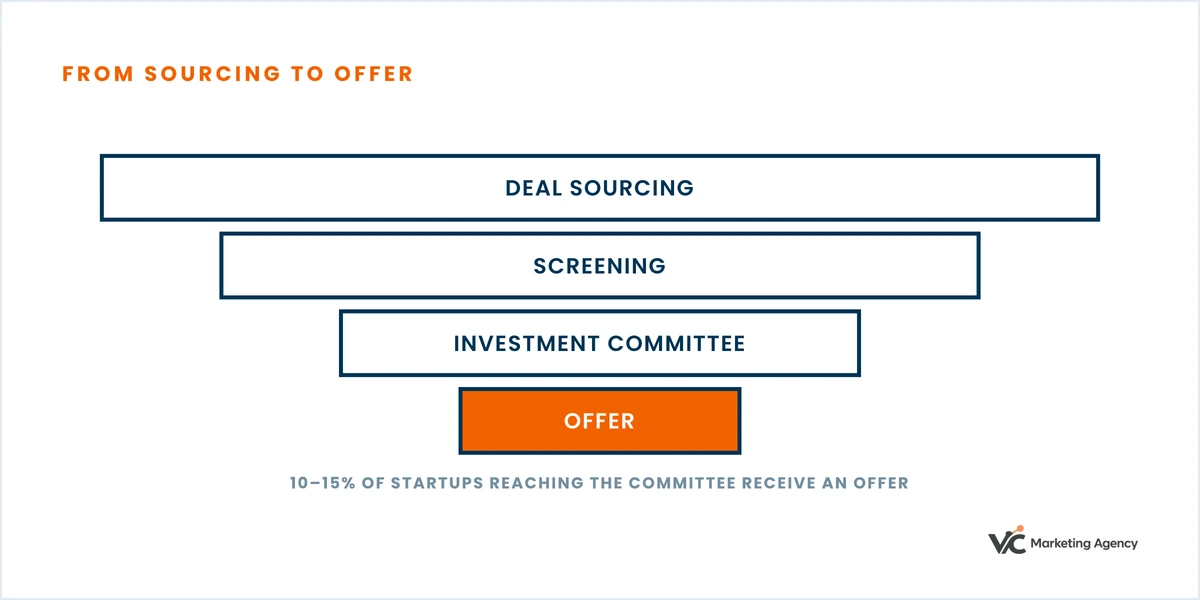
A venture capital firm evaluates startups before investing by running each opportunity through a narrowing screening funnel and scoring it against a fixed set of selection criteria. Deal sourcing pulls candidates from founder networks, accelerator programs, portfolio-founder referrals, thesis-driven outbound research, and data-driven sourcing platforms that flag startups matching the firm’s target profile. Screening then narrows the pool sharply: industry deal-flow data shows only 10-15% of startups that reach an investment committee meeting receive an offer, out of a far larger group reviewed at the sourcing stage.
Selection criteria center on six factors. Founding-team experience and balanced skill sets tend to decide the outcome at the earliest stages, since execution ability outweighs early product details. Total addressable market (TAM) size determines whether the opportunity can return the fund, ruling out startups chasing structurally small markets. Early traction, measured in users, revenue, or engagement, signals product-market pull, while competitive moat (technology, network effects, data, or distribution) protects the startup from faster-moving rivals. Valuation relative to stage and growth trajectory sets the risk-reward math, and fit with the firm’s sector focus, stage mandate, and investment thesis determines whether the deal belongs in the portfolio at all.
Startups that clear the initial screen advance to partner-level discussion before moving into formal due diligence, where the firm verifies each claim behind the investment decision.
What happens during due diligence at a venture capital firm?
Due diligence at a venture capital firm proceeds through four sequential workstreams: financial, legal, commercial/market, and technical. Financial diligence audits revenue recognition, burn rate, and unit economics; legal diligence reviews corporate structure, IP ownership, and contracts; commercial diligence tests market-sizing and customer-demand claims; technical diligence assesses product architecture and the engineering team’s execution capacity. Reference checks with former colleagues, customers, and investors, paired with a full cap-table review confirming ownership percentages and prior funding terms, round out the process.
Completed diligence clears the firm to move from verification into negotiation, translating due-diligence findings into the terms the firm proposes in the term sheet.
What is included in a venture capital term sheet?
A venture capital term sheet defines the ownership, control, and economic terms of an investment before legal documents are drafted, and its key components are listed below:
- Pre-money and post-money valuation: Pre-money valuation values the startup before the new investment; post-money valuation adds that investment to the total, setting the investor’s ownership percentage.
- Equity percentage: Equity percentage states the ownership stake the venture capital firm receives in exchange for its capital.
- Preferred shares: Preferred shares give investors rights senior to common stockholders, including priority in dividends and payout order.
- Liquidation preference and its multiple: Liquidation preference guarantees investors get paid before common shareholders in an exit, with the multiple (1x, 2x, or higher) setting how many times their investment they recover first.
- Board seats: Board seats grant the venture capital firm formal voting power over major company decisions.
- Pro-rata rights: Pro-rata rights let the investor maintain its ownership percentage by participating in future funding rounds.
- Anti-dilution provisions: Anti-dilution provisions protect the investor’s ownership value if the company raises a later round at a lower valuation.
- Option-pool sizing: Option-pool sizing sets aside a percentage of equity for employee stock options, carved out of the pre-money valuation before the round closes.
What funding stages do venture capital firms invest across?
Venture capital firms deploy capital across six sequential funding stages, from pre-seed through late-stage growth rounds, with check sizes expanding as a startup matures and risk declines. Carta’s State of Private Markets: 2025 in Review tracks check-size ranges and medians across every stage, giving founders and investors a consistent benchmark for round sizing. Each stage below carries its own capital range, funding purpose, and dominant investor type.
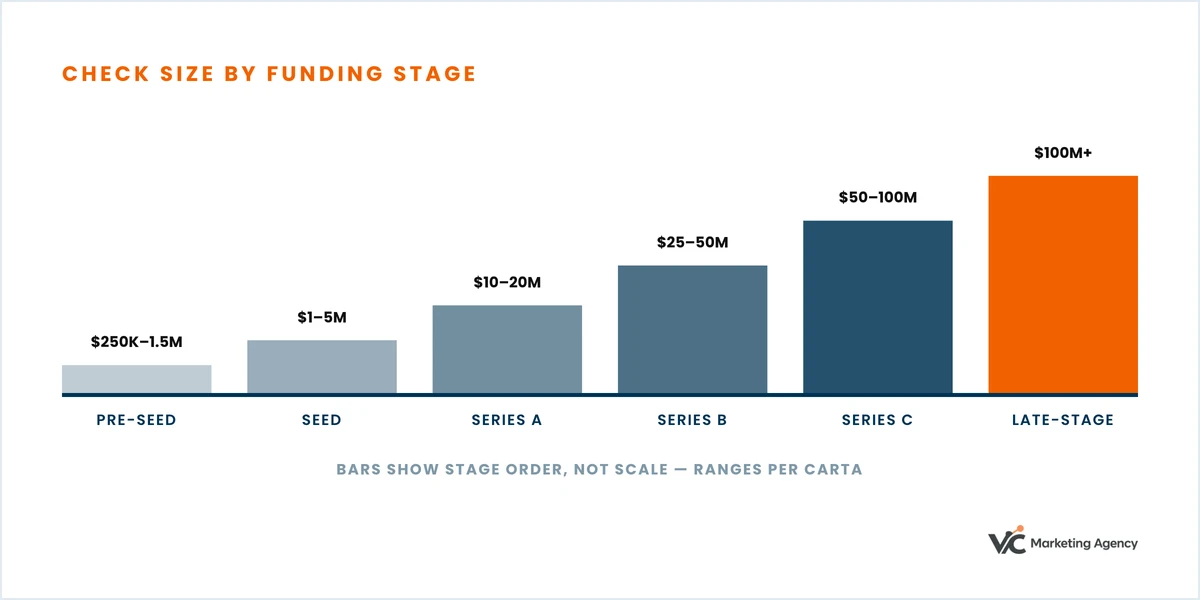
Pre-Seed Funding — Pre-seed rounds raise roughly $250,000 to $1.5 million, with a median near $1 million. Pre-seed capital funds initial product development, validates the core business concept, and assembles the founding team before measurable traction exists. Angel investors, friends and family, and dedicated pre-seed funds or accelerators such as Y Combinator and Techstars supply pre-seed capital.
Seed Funding — Seed rounds raise between $1 million and $5 million, with a median between $3 million and $3.2 million. Seed capital drives a startup toward product-market fit, funds the initial go-to-market motion, and builds out the core early team. Seed-stage VC funds, micro-VCs, and angel syndicates lead seed rounds.
Series A Funding — Series A rounds raise $10 million to $20 million, with medians trending toward $19 million to $20 million in late 2025 and early 2026. Series A capital scales a proven business model, formalizes sales and marketing engines, and deepens product development. Institutional venture capital firms make their first lead-investor commitment at Series A.
Series B Funding — Series B rounds raise $25 million to $50 million, with a median near $40 million. Series B capital expands market reach, scales operations and headcount, and strengthens the senior leadership team. Venture capital firms invest alongside growth equity investors entering the cap table at Series B.
Series C Funding — Series C rounds raise $50 million to $100 million or more. Series C capital funds geographic or product-line expansion, fuels acquisitions, and prepares a company for late-stage scale. Growth equity firms, hedge funds, investment banks, and private equity investors lead Series C rounds, usually alongside existing VCs following on.
Late-Stage and Growth Funding — Late-stage rounds, spanning Series D and beyond, raise $100 million and up, sometimes reaching several hundred million dollars. Late-stage capital solidifies market dominance, drives pre-IPO growth, and funds major strategic moves ahead of an exit. Private equity firms, sovereign wealth funds, mutual funds, and crossover investors invest alongside late-stage VC investors during Series D and later rounds.
Seed Stage Funding
Seed stage funding targets product-market fit and builds the early founding team around a validated concept. A seed round funds customer discovery, initial hires, and the first version of a product ready for market testing. Angel investors and seed funds supply the bulk of seed capital, structuring the investment through SAFE agreements or convertible notes rather than priced equity rounds.
SAFE and convertible note instruments let seed investors defer valuation until a future priced round, reducing negotiation time during an early stage with little data. Traction gained during the seed round (early revenue, user growth, or engagement metrics) positions a startup for the larger, metric-driven rounds that follow at Series A.
Series A Series B and Series C Funding
Series A funding scales a startup’s product-market fit and expands the founding team into a fuller organizational structure, requiring evidence of repeatable customer demand before an institutional lead investor commits capital. Series B funding scales growth, directing capital toward market expansion, headcount, and operational infrastructure once a company demonstrates consistent revenue traction and improving unit economics. Series C funding scales expansion and pre-IPO readiness, funding geographic growth, acquisitions, and leadership depth for companies with proven, scalable business models.
Revenue traction and unit economics gate progression through each round, with investors measuring monthly recurring revenue growth, customer acquisition cost, and gross margin before committing capital. Growth investors, including growth equity firms and crossover funds, enter alongside traditional venture capital firms at Series B and Series C, bringing larger check sizes suited to scaling operations.
How do venture capital firms manage portfolios?
Venture capital firms manage portfolios by setting a concentration strategy upfront, choosing how many startups to back and how much capital to hold in reserve for the strongest performers. Concentrated funds commit to 10 to 15 companies to preserve meaningful ownership stakes in each business, while diversified funds spread capital across 20 to 40 or more startups to raise the odds of catching an outlier return. Fund managers reserve 40% to 60% of total capital (sometimes up to 70%) for follow-on investments, usually applying a ratio of two reserved dollars for every dollar committed at the initial check, so winning companies receive continued backing through later funding rounds without a new fund.
Follow-on strategy ranks as the single most consequential lever in portfolio management. Rather than spreading reserves evenly across every holding, venture capital firms concentrate additional capital behind their highest-conviction positions once traction confirms the original investment thesis. Board-level governance reinforces that discipline: the lead investor on a funding round holds a board seat carrying voting authority over executive compensation, strategic direction, and future financings; firms without a board seat secure board observer rights instead, granting visibility into company performance without formal voting power.
Power-law return dynamics drive every construction and governance decision venture capital firms make, since a small share of portfolio investments generates the majority of fund profit. A 2014 Correlation Ventures analysis of 21,640 U.S. venture financings made between 2004 and 2013 found that roughly two-thirds of venture investments returned less than the capital invested, while only 5% to 7% of deals returned more than ten times their investment, with that minority driving nearly all fund-level gains. Because a single outlier investment can return an entire fund, venture capital firms build portfolios not to minimize the number of losing investments, but to secure enough ownership in the eventual winner to carry fund-level returns.
How do venture capital firms support portfolio companies after investing?
Venture capital firms support portfolio companies after investing through board seats that grant direct input into strategic decisions, hiring plans, and governance structure. Partners contribute operational and strategic guidance drawn from experience scaling comparable businesses, helping founding teams refine go-to-market plans, pricing models, and organizational structure as the company grows. Investment teams assist with executive hiring by screening candidates for senior leadership roles such as chief financial officer, chief marketing officer, and vice president of sales, drawing on networks built across hundreds of prior placements.
Firms open customer and investor introductions that connect portfolio companies to potential enterprise clients, strategic partners, and later-stage investors positioned to lead follow-on rounds. Follow-on funding from the original venture capital firm signals continued confidence to outside investors, in many cases anchoring a new financing round and setting valuation terms for co-investors joining the syndicate.
How do venture capital firms market their own portfolio companies?
Venture capital firms market portfolio companies by deploying in-house marketing teams or dedicated platform resources that extend beyond board-level guidance into hands-on execution. Public relations campaigns secure press coverage in target trade publications and mainstream business media, building credibility that shortens sales cycles and attracts talent. Brand building establishes consistent visual identity, messaging, and market positioning across a portfolio company’s website, product materials, and customer-facing channels, while go-to-market strategy support shapes pricing, channel selection, and launch sequencing for new products entering competitive markets.
Demand generation programs (content marketing, paid acquisition, search visibility, and account-based outreach) feed qualified leads into a portfolio company’s sales pipeline, directly accelerating revenue growth between funding rounds. Marketing support across an entire portfolio requires dedicated execution, which leads many venture capital firms to select a marketing partner built for the venture industry.
Why choose Venture capital marketing agency for VC portfolio growth?
Venture Capital Marketing Agency partners with venture capital firms to scale portfolio company growth through marketing programs built for the venture funding lifecycle. Our digital agency for venture capital firms delivers the following advantages to every portfolio engagement:
- We work exclusively with venture-backed companies, from seed through growth stage.
- We embed quickly, launching PR and demand generation within tight funding-round windows.
- We report growth metrics directly to portfolio operating partners.
- We scale consistent brand execution across an entire portfolio at once.
- We unify PR, brand building, and demand generation under one team.
How do venture capital firms generate profit?
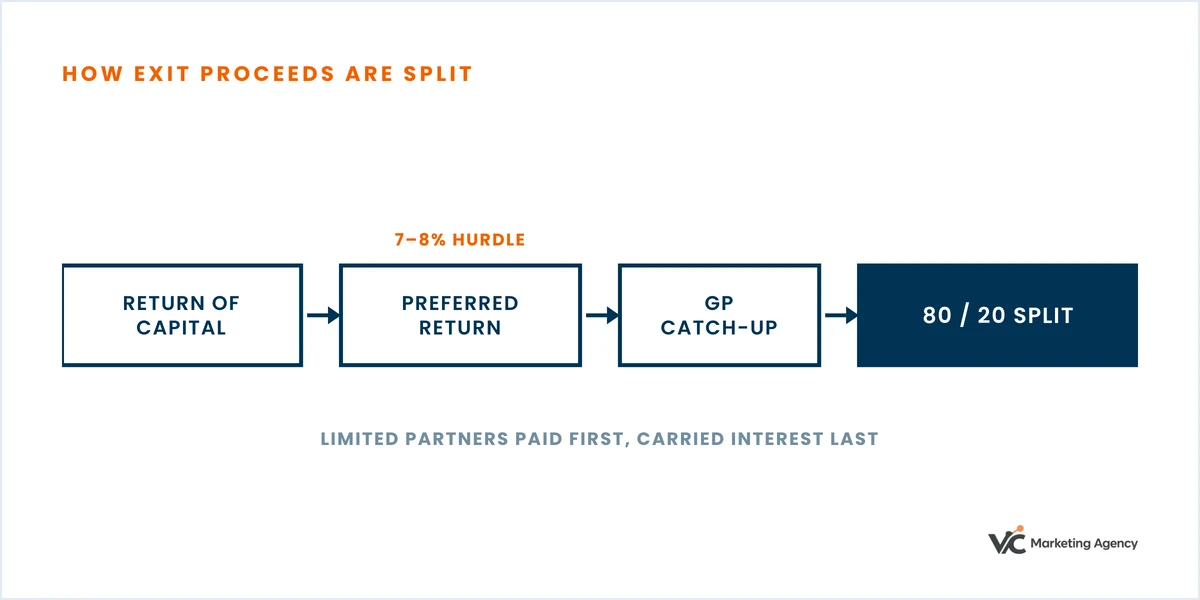
Venture capital firms generate profit through two income streams: management fees and carried interest, both tied to the eventual exit of portfolio companies. The management fee, set near 2% of committed capital annually, funds the firm’s operating costs (salaries, due diligence, and overhead) regardless of fund performance. Carried interest functions as the firm’s true profit engine, granting general partners roughly 20% of investment profits only after the fund returns capital to limited partners and clears a hurdle rate near 7% to 8%, according to Carta’s guide to carried interest in private funds.
Fund returns follow a waterfall structure rather than an immediate split. Limited partners first recover their invested capital, then receive the preferred return up to the hurdle rate. The general partner then receives a catch-up allocation, and the remaining profit divides roughly 80/20 between limited partners and general partners. Carta’s fund-performance metrics resource documents this sequence as the distribution waterfall. Two metrics track that progression: DPI (Distributions to Paid-In Capital) measures cash already returned to limited partners, while TVPI (Total Value to Paid-In Capital) adds the unrealized value of remaining holdings, as AngelList’s investor education center defines both benchmarks.
Carried interest depends on realized gains, so general partners collect no meaningful profit until portfolio companies convert paper value into cash. That conversion happens through the exits detailed below.
What are the exit strategies for venture capitalists?
Venture capitalists realize fund profit through three exit routes, each converting an equity stake into distributable cash for limited partners and general partners alike. The exit strategies for venture capitalists are listed below:
- IPO (Initial Public Offering): the portfolio company lists shares on a public exchange, delivering full liquidity through the slowest route, commonly exceeding eight years from initial investment.
- Acquisition or trade sale (M&A): a strategic buyer or larger company purchases the startup outright, forming the most common exit route and closing near six to seven years after investment.
- Secondary sale: the fund sells its stake to a different investor, such as a later-stage venture firm, private equity buyer, or secondary specialist, releasing liquidity before an IPO or acquisition occurs.
Each exit route converts a venture capital firm’s paper gains into the realized cash that becomes the fees and carried interest distributed to general and limited partners alike.