Venture capital is equity financing provided to early-stage, high-growth, high-risk startups that lack collateral or access to traditional bank lending. A venture capital firm manages the pooled fund that invests that capital in exchange for equity. The venture capital cycle starts with raising a fund from limited partners and moves through deal sourcing, due diligence, equity investment, portfolio support, and an exit by acquisition or initial public offering (IPO).
Recognizable venture capital firms such as Sequoia Capital, Andreessen Horowitz, and Accel anchor the industry and back landmark companies across technology, healthcare, and financial services. Venture capital firms themselves grow by sharpening their investment thesis, refining brand positioning, and building networks among founders and limited partners. Equity financing on those terms suits scalable startups whose business models can produce outsized outcomes.
Venture capital funding stages advance in sequence from seed rounds through later-stage rounds, and the venture capital firm deploys capital at each step of that ladder.
What is a Venture Capital firm?
A venture capital firm is an organization that manages a pooled investment fund and directs capital into early-stage, high-growth startups in exchange for equity. The firm acts as manager, while the fund holds the capital raised from limited partners. Separating the two matters because the venture capital firm sets investment strategy and selects companies that fit its investment thesis.
Venture capital firms operate on an equity-for-capital model, supplying funding in return for ownership stakes in portfolio companies. Firm revenue comes from management fees and carried interest. Management fees of around 2% of committed capital cover operating costs, while carried interest of about 20% of profits above a defined threshold rewards performance.
The dual revenue model ties the venture capital firm’s earnings to the results it produces for limited partners and portfolio companies alike.
How does venture capital differ from angel investing?
Venture capital differs from angel investing in capital source, check size, entry stage, and level of involvement. Venture capital deploys pooled institutional money through a managed fund, while angel investing deploys an individual investor’s personal money. The differences between venture capital and angel investing are listed below:
| Aspect | Venture Capital | Angel Investing |
|---|---|---|
| Capital Source | Pooled institutional money raised by venture capital firms from limited partners such as pension funds, endowments, and family offices. | Personal money from individual angel investors, usually former founders, executives, or wealthy individuals investing on their own behalf. |
| Typical Check Size | Larger checks, ranging from hundreds of thousands to millions of dollars, reflecting institutional backing. | Smaller checks, from tens of thousands to a few hundred thousand dollars per angel, though syndicates can write larger combined checks. |
| Entry Stage | Enters at seed, Series A, and later stages once product or market traction is visible. | Enters earlier, including pre-seed and seed stages, when the startup remains highly uncertain and not yet ready for institutional venture capital. |
| Level of Involvement | Structured involvement, including due diligence, board seats, portfolio support, and formal governance through the fund manager. | Lighter and more informal, though some angels mentor founders or open network access without formal governance rights. |
How does venture capital differ from private equity?
Venture capital differs from private equity in company maturity, stake type, use of leverage, and risk profile. Venture capital funds early-stage startups with minority equity positions and almost no debt, while private equity funds mature companies with controlling stakes and substantial leverage. The differences between venture capital and private equity are listed below:
| Aspect | Venture Capital | Private Equity |
|---|---|---|
| Company Maturity | Early-stage startups and emerging companies with high growth potential and high uncertainty, concentrated in information technology, biotechnology, software, fintech, and digital infrastructure. | Mature, established companies that have reached scale with proven products, stable cash flows, and reduced risk profiles. |
| Stake Type | Minority equity stakes acquired in exchange for capital, paired with strategic advisory roles that help shape the business model. | Growth equity and buyout positions that carry majority or controlling stakes, giving the investor stronger operational control. |
| Use of Leverage and Debt | Equity financing with minimal to no debt, since startups lack collateral or access to traditional bank lending. | Frequent use of leverage and debt financing to fund acquisitions and buyouts, which amplifies returns and raises risk. |
| Risk Profile | High risk from early-stage failure rates, offset by outsized returns where a few winners cover many losses under a power-law dynamic. | Lower risk than venture capital, resting on established companies with proven business models, predictable cash flows, and existing market presence. |
What is the history of venture capital?
The history of venture capital begins in the post-World War II era, when high-risk commercial financing became an organized industry. American Research and Development Corporation (ARDC) opened the modern chapter by supplying capital to businesses run by returning soldiers. Families such as the Rockefellers and institutions such as Warburg Pincus shaped the early venture capital industry.
The rise of Silicon Valley in the late 20th century pulled venture capital toward technology and innovation, with Arthur Rock among the investors who drove that shift. Legislative change in the 1970s, including the Employee Retirement Income Security Act (ERISA) and reductions in capital gains tax, opened pension money to the asset class and expanded it sharply.
Internet investment produced a venture capital boom in the 1990s that funded Netscape and Amazon. The dot-com bubble burst in 2000, losses mounted, and the industry contracted before recovering through the early 2000s.
How does venture capital work?
Venture capital works through a structured investment cycle that opens with fundraising. Venture capital firms raise capital from limited partners such as pension funds and high-net-worth individuals. Once the fund closes, the firm enters deal sourcing and evaluates startups to identify high growth potential, then runs due diligence on business model, market opportunity, and competitive position before making an equity investment.
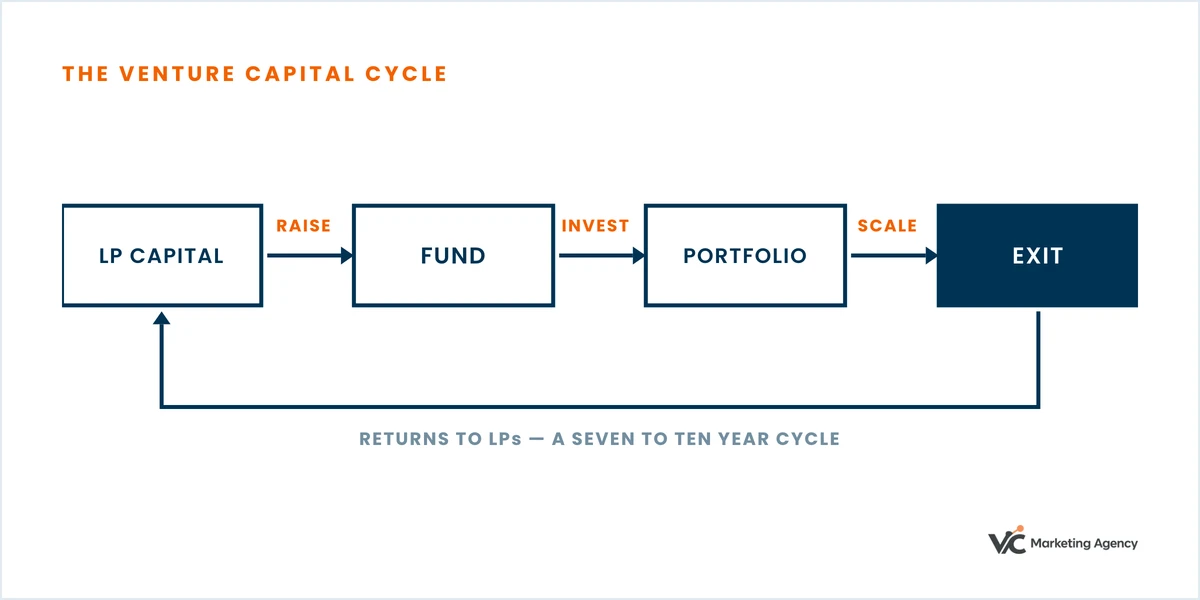
After investing, venture capitalists support portfolio companies with strategic guidance and introductions. The goal is a profitable exit through acquisition or initial public offering (IPO). Returns follow a power-law dynamic in which one or two investments in a portfolio produce the bulk of the gains and offset the failures that early-stage investing produces. An analysis of 1,808 early-stage investments confirmed that venture returns fit a power-law distribution with a heavy right tail of very high multipliers, according to “What AngelList Data Says About Power-Law Returns In Venture Capital” by Abe Othman, AngelList, June 2020.
The full venture capital cycle from fundraising to exit runs roughly seven to ten years. The ten-year horizon rests on a fund structure that aligns incentives between investors and fund managers and supplies the patient capital startups need to scale. Each step of that cycle is traced in how venture capital firms work, from capital calls and deal screening through to the exit waterfall.
What is the fund structure of a venture capital firm?
The fund structure of a venture capital firm rests on a pooled limited-partner model. Limited partners such as pension funds and high-net-worth individuals commit capital that is not transferred at once; capital calls arrive as the firm identifies investment opportunities. A venture capital fund runs for roughly ten years, during which the firm deploys capital, supports portfolio growth, and works toward exits by acquisition or IPO.
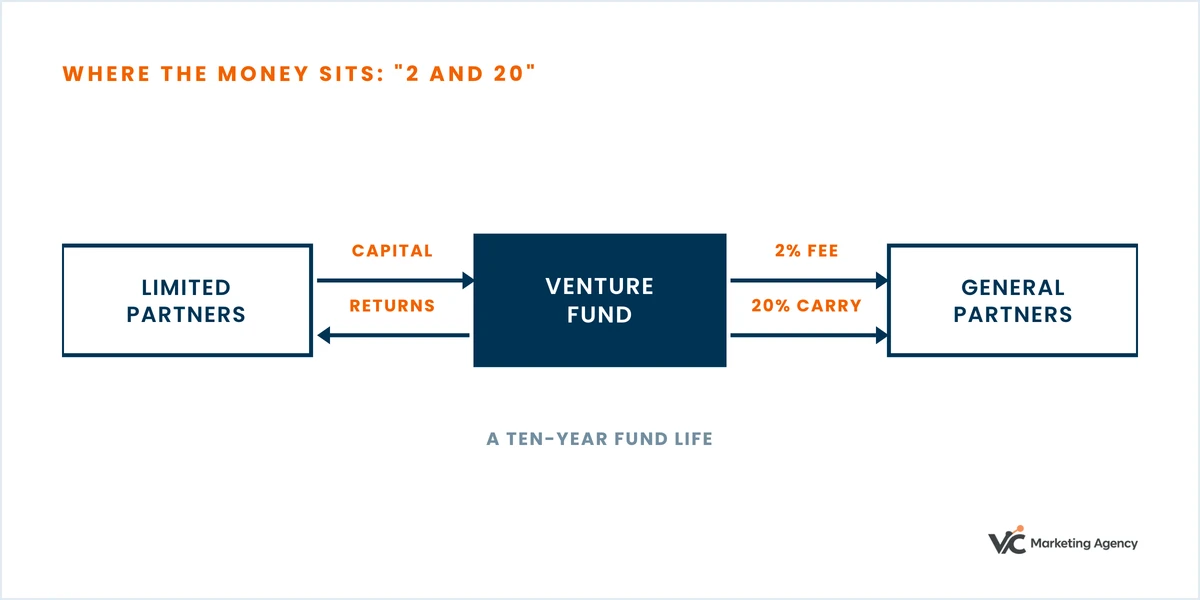
Fund economics rest on management fees and carried interest. Management fees of around 2% of committed capital each year cover operating costs, while carried interest set at about 20% of fund profits rewards general partners for performance. As portfolio companies exit, returns flow back to limited partners under the fund’s terms.
The “2 and 20” arrangement is the common industry standard, though the numbers move with fund size and market conditions. Research covering 238 funds raised between 1993 and 2006 found that roughly two-thirds of a manager’s expected revenue comes from fixed fee components rather than performance-based carried interest, according to “The Economics of Private Equity Funds” by Andrew Metrick and Ayako Yasuda, published in the Review of Financial Studies, June 2010.
What is the role of general partners in a venture capital fund?
General partners (GPs) in a venture capital fund are the managers responsible for the fund’s performance. General partners run fund operations, make investment decisions, and take board seats at portfolio companies to supply strategic direction. Compensation reaches them through management fees of around 2% of assets under management and carried interest of about 20% of fund profits.
General partners commit their own capital alongside limited partners, which ties their financial outcome to the fund’s results and pushes them to drive performance for every investor in the fund.
What is the role of limited partners in a venture capital fund?
Limited partners (LPs) in a venture capital fund are the capital providers who supply the money the firm invests in startups and early-stage companies. Limited partners hold a passive role and stay out of day-to-day management and investment decisions.
Common limited partners include institutional investors such as pension funds, university endowments, family offices, and high-net-worth individuals. Those investors commit capital to venture capital funds in pursuit of high returns while accepting the risk that early-stage investing carries.
What are some examples of venture capital firms?
Venture capital firms fund and support innovative startups across industries. The most prominent venture capital firms are listed below:
- Sequoia Capital: backed Apple, Google, and YouTube, along with Instagram, Stripe, and WhatsApp, and stands among the leading Silicon Valley firms.
- Andreessen Horowitz (a16z): invested in Facebook, Airbnb, and Coinbase, with strong influence in consumer technology and cryptocurrency.
- Accel: made early investments in Facebook, Dropbox, and Slack, with a presence in social media, enterprise software, and collaboration tools.
- Benchmark: backed eBay, Twitter, and Uber, and is known for its equal-partnership model and concentrated portfolio.
- Kleiner Perkins: invested in Amazon, Google, and Genentech across both technology and biotechnology.
- Greylock Partners: invested in LinkedIn, Airbnb, and Discord, specializing in enterprise software and consumer internet platforms.
- Lightspeed Venture Partners: backed Snapchat, Nest, and Affirm, concentrating on enterprise technology and consumer innovation.
- Index Ventures: backed Dropbox, Slack, and Revolut, bridging the US and European technology markets.
- Ribbit Capital: specializes in fintech, with investments in Robinhood, Coinbase, and Affirm.
- Y Combinator: an accelerator with early investments in Airbnb, Dropbox, and Stripe, running the best-known startup accelerator program worldwide.
How do Venture Capital Firms Grow?
Venture capital firms grow through brand positioning, deal-flow acquisition, and differentiation in a competitive market. Growth starts with defining and communicating the firm’s investment thesis, which draws founders whose businesses match the firm’s focus and limited partners pursuing exposure to sectors such as AI, fintech, or biotech.
Brand and thesis positioning. Venture capital firms build a recognizable brand by articulating a clear investment thesis, naming the companies they want to support, and signaling sector focus with consistency. Firms that position with precision stand out in a crowded market and hold the attention of founders and limited partners.
Deal-flow acquisition. Deal flow drives firm growth. Successful firms build networks that generate inbound opportunities through relationships with founders and limited partners, and the quality of incoming deals rises as the firm earns a reputation for adding value.
Differentiation. Firms separate themselves through sector specialization, geographic focus, and value-add capabilities such as operational support or executive recruiting. Marketing and thought leadership sharpen that separation and establish authority in the chosen domain.
What is marketing for Venture Capital firms?
Marketing for venture capital firms is the set of activities that communicate the firm’s brand, investment thesis, and value proposition to founders and limited partners. Brand and thesis positioning states the firm’s investment focus, target stages, and distinguishing approach against competitors.
Thought-leadership content carries that position outward. Firms publish market analysis and commentary to build credibility and visibility among startups. Limited-partner marketing presents the firm’s track record, fund performance, and strategic direction to institutional investors, endowments, family offices, and high-net-worth individuals.
Deal-flow marketing works the founder-facing side, opening channels through events, networks, and content that attract high-quality startups raising capital. As competition among firms intensifies, marketing shifts from a passive function to a strategic driver of firm growth. Those activities form a discipline in their own right, and venture capital marketing covers how firms build and measure it across both audiences.
What is the importance of marketing for Venture Capital firms?
Marketing matters for venture capital firms because it secures high-quality deal flow. A firm with visibility among founders, accelerators, and other market participants sees promising startups first.
Marketing carries equal weight in limited-partner fundraising and relationship management. Presenting a firm’s track record, strategy, and team builds confidence among institutional investors such as pension funds and endowments.
Marketing separates a venture capital firm in a crowded market. Clear brand and thesis positioning, delivered through thought-leadership content and consistent communication with founders and investors, makes a firm the preferred choice and gives it first access to the best investment opportunities. Sustaining that positioning demands consistent output over years, which is why many firms retain a VC marketing agency to carry the work alongside the investment team.
Who Needs Venture Capital?
Venture capital suits scalable startups and founders who lack collateral but hold high growth potential. Those startups cluster in software, biotechnology, fintech, and artificial intelligence, where rapid expansion demands substantial capital. The characteristics that make a company suited to venture capital are listed below:
- Scalable business models: companies whose revenue can grow without proportional cost increases, including software companies and digital platforms.
- Large addressable markets: companies targeting expansive markets with strong demand, which supports long-term growth.
- Proprietary technology or business models: startups whose technology or commercial approach creates a competitive advantage.
- High upfront costs or long commercialization timelines: industries such as biotechnology, where research and regulatory approval precede revenue.
Venture capital funds a startup without requiring repayment if the company fails, and that protection carries trade-offs. Equity dilution reduces founder ownership, and investors gain board seats and influence over strategic decisions. Exit timelines follow the fund’s schedule rather than the founder’s preference, so venture capital fits startups that need substantial capital and accept shared ownership and shared decision-making.
What are the stages of venture capital funding?
Venture capital funding moves through stages that match a startup’s growth phase, each supplying capital and support suited to that phase. The stages of venture capital funding are listed below:
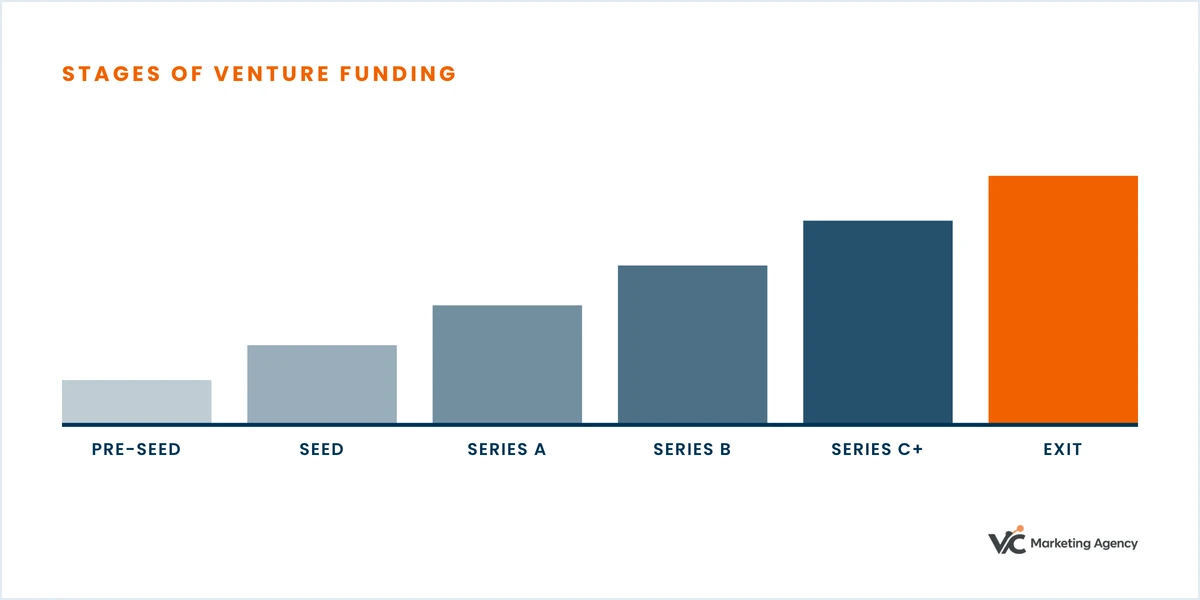
Pre-seed stage. Pre-seed is the earliest phase, funded by personal savings, friends and family, or first angel checks. Founders validate the business concept and build a minimum viable product (MVP), establishing whether the idea can work.
Seed stage. Seed funding is the first institutional round and supports product development and market validation. Startups finish a first product, attract early users, and demonstrate demand, aiming for the traction metrics that draw larger investors.
Series A stage. Series A funds startups with a proven product and early traction. Capital at that stage scales the business model, expands the team, and drives customer acquisition, and investors require clear growth metrics and a route to profitability.
Series B stage. Series B supplies growth capital to companies that have reached product-market fit. Funding supports aggressive scaling, entry into new markets, and the infrastructure that rapid growth demands.
Series C and later stages. Series C and subsequent rounds supply growth and expansion capital to mature startups preparing for market leadership, geographic expansion, or acquisitions of competitors. Later-stage rounds draw private equity investors, hedge funds, and corporate venture arms.
Exit stage. The exit stage is where investors realize returns through an initial public offering (IPO) or acquisition. Equity stakes convert into realized capital and profits flow back to limited partners, closing the venture capital investment cycle.
What is seed funding in venture capital?
Seed funding in venture capital is the earliest stage of institutional investment, supplying capital to build a first product and validate market fit. Seed rounds follow support from friends, family, or angel investors and represent the first formal equity investment from venture capital firms.
Seed capital lets a startup develop a minimum viable product, run market testing, and establish early customer traction. Reaching product-market fit and hitting development milestones positions the startup for Series A, where a proven business model scales on larger capital and tighter growth metrics.
What is Series A funding in venture capital?
Series A funding in venture capital is the round where a startup moves from validating its concept to scaling a proven business model. Companies raise from several million to tens of millions of dollars at that stage to accelerate growth and capture market share.
Series A capital builds the infrastructure that sustainable scaling requires, including key hires, a refined go-to-market strategy, and repeatable revenue models. Investors examine customer acquisition efficiency, retention rates, and revenue growth as evidence the business can scale profitably.
Roman Health Ventures, now Ro, raised $88 million in a 2018 Series A round led by FirstMark Capital that established its position in telehealth. With Series A capital secured and growth metrics validated, startups position themselves for Series B and Series C rounds and eventual exit.
What is later-stage funding in venture capital?
Later-stage funding in venture capital covers Series B, Series C, and subsequent rounds raised by companies that have validated their business models and built consistent revenue. Capital from those rounds goes toward growth and expansion.
Growth and expansion capital lets companies scale production, deepen market penetration, and strengthen technical infrastructure. Companies use later-stage rounds to hire, widen product lines, and increase marketing investment.
Pre-IPO scaling prepares a company for public markets. Business processes tighten, financial reporting strengthens, and the company aligns with regulatory standards, which positions it for an IPO or acquisition.
Which industries attract the most venture capital funding?
The industries that attract the most venture capital funding are information technology and software, biotechnology and life sciences, fintech, and artificial intelligence. Each combines high growth potential, technological innovation, and scalability. The leading sectors are listed below:
Information technology and software. Software receives the largest share of venture capital investment, supported by rapid scalability, recurring revenue models, and global reach. Software-as-a-Service (SaaS) platforms, cloud computing, and enterprise software dominate the category.
Biotechnology and life sciences. Biotechnology draws venture capital because successful drugs and treatments generate substantial revenue while meeting healthcare needs. Long development timelines and regulatory review have not deterred investors, and the COVID-19 pandemic accelerated capital flows into the sector.
Fintech. Fintech startups rebuild banking, payments, lending, and wealth management on technology. Investors back companies that remove inefficiency from legacy financial systems, widen financial inclusion, and deliver digital experiences, from mobile payment platforms to cryptocurrency exchanges and digital banking.
Artificial intelligence and machine learning. Artificial intelligence is the fastest-growing category for venture capital allocation, serving as foundational infrastructure across healthcare, finance, transportation, manufacturing, and consumer applications. CB Insights reports that AI-related companies captured about 48% of global venture funding in 2025, roughly $226 billion, the largest share on record.