A biotech venture capital firm is a specialist investor that funds life-science and drug-development startups, supplying scientific and operational support alongside capital. The ten firms profiled below are Flagship Pioneering, ARCH Venture Partners, Third Rock Ventures, OrbiMed, Sofinnova Partners, RA Capital Management, Polaris Partners, Atlas Venture, Versant Ventures, and 5AM Ventures, each covered by founding year, headquarters, fund size, investment stage, therapeutic focus, and notable portfolio.
Biotech venture capital firms are classified by investment stage and by structure, spanning independent funds, corporate venture arms, and disease-focused vehicles. They separate from generalist venture firms through heavier scientific diligence, longer development timelines, and more hands-on company building. Evaluation runs on platform and scientific validation, intellectual property, team strength, and regulatory pathway, and capital arrives in staged rounds from seed cheques of $1–5 million to later rounds above $50 million.
Biotech venture firms target fund-level multiples of 3–5x and internal rates of return of 20–30%. Value reaches portfolio companies through company creation, board governance, management recruiting, and pharma partnerships. Flagship Pioneering shows the model at full extension, having originated Moderna inside its own foundry.
1. Flagship Pioneering

Flagship Pioneering is a biotech venture capital firm founded in 2000 and based in Cambridge, Massachusetts, managing over $10 billion in assets with a focus on early-stage life-science companies. The firm runs a foundry model, creating and incubating companies internally rather than backing external startups alone, which lets it build ventures from inception on its own scientific theses.
Moderna is the firm’s defining outcome, an mRNA therapeutics company Flagship originated in house. Flagship has founded many other biotech companies through the same innovation model, including Mirai Bio.
Flagship continues to widen its position in biotech by building therapeutic platforms and forming strategic collaborations, among them a partnership with Thermo Fisher in 2025.
2. ARCH Venture Partners

ARCH Venture Partners is an early-stage biotech venture capital firm established in 1986 that concentrates on Series A through Series C rounds in life sciences and therapeutics. The firm manages roughly $12 billion in assets and closed ARCH Venture Fund XIII at more than $3 billion in September 2024, following the $2.975 billion Fund XII announced in June 2022.
ARCH separates itself through cross-border investing across the United States, China, and the United Kingdom, which gives portfolio companies access to international markets and regulatory experience.
ARCH backed Illumina and Juno Therapeutics, both markers of its appetite for scientifically ambitious ventures. Its approach combines high deal volume with flexibility, writing small formative cheques at seed and supporting large follow-on financings from the same portfolio position.
3. Third Rock Ventures

Third Rock Ventures is a biotechnology venture capital firm founded in 2007 and based in Boston, Massachusetts, built around early-stage company creation and incubation. The firm launched with a $378 million first fund and has since raised larger vehicles, including a $1.1 billion fund.
Company creation rather than passive investing defines the Third Rock model. The firm builds startups from the ground up around platform technologies with multiple product opportunities, working with scientific founders and assembling management teams that turn discoveries into integrated companies. Capital arrives alongside strategic direction, operational infrastructure, and a network of scientific advisers.
Bluebird Bio stands out among Third Rock’s outcomes, its gene therapy for sickle cell disease having won FDA approval, which shows the firm carrying science from concept through to an approved therapy.
4. OrbiMed

OrbiMed is one of the largest dedicated healthcare investment firms in the world, founded in 1989 and headquartered in New York, managing approximately $20 billion across public and private investments. The firm runs a multi-stage model spanning private equity, public equity, and crossover investing, which lets it support companies from early development into the public markets.
Global reach and a large capital base let OrbiMed lead sizeable financings, including a $183 million Series C for Electra and strategic licensing arrangements through portfolio companies such as Vanqua Bio. In August 2025 the firm raised $1.86 billion for its Royalty and Credit Opportunities Fund V.
Bridging private and public markets is what distinguishes OrbiMed’s strategy, letting it hold long-term positions in therapies and platforms as they mature and commercialize.
5. Sofinnova Partners

Sofinnova Partners is a European life sciences venture capital firm founded in 1972 and headquartered in Paris, managing over €4 billion with a focus on early-stage biopharma and medtech. The firm acts as founding or lead investor at seed and early stage, supporting companies from formation through early development.
Successive fund vintages track the firm’s growth: Capital VI in 2008 at €260 million, Capital VII in 2012 at €240 million, Capital VIII in 2015 at €300 million, Capital IX in 2018 at €333 million, Capital X in 2021 at €472 million, and Capital XI in 2025 at €650 million.
A European focus separates Sofinnova within the global biotech market. Its Paris base supplies command of the scientific and regulatory conditions particular to European markets, and its networks across European research institutions, hospitals, and pharmaceutical partners feed both sourcing and company building.
6. RA Capital Management

RA Capital Management is a Boston-based biotech venture capital firm founded in 2001 that manages over $10 billion and runs a crossover investing model across private and public biotechnology companies. Its strategy stretches from early clinical development into public market growth.
TechAtlas, the firm’s internal research engine, maps therapeutic areas and guides investment decisions with scientific and market intelligence, which lets RA Capital identify novel mechanisms and platform technologies aimed at unmet medical need. Recent activity includes a $250 million investment partnership with OMERS Life Sciences in ARS Pharmaceuticals.
The crossover model closes the usual gap between private venture capital and public biotech investing, letting RA Capital hold positions as companies move from private rounds through IPO and beyond.
7. Polaris Partners

Polaris Partners is a venture capital firm founded in 1996 and based in Boston, Massachusetts, managing over $5 billion in committed capital across multiple funds. The firm invests across stages in both healthcare and technology, supporting companies from inception through later growth phases.
Backing founding teams sits at the centre of the Polaris philosophy. The firm works directly with founders, supplying strategic and operational support shaped to each company rather than a fixed template, which has produced long-running relationships across life sciences and technology.
Cross-industry perspective is what Polaris brings to its biotech positions, applying practices from the wider innovation economy to therapeutic and platform companies.
8. Atlas Venture

Atlas Venture is a biotech venture capital firm founded in 1980 and headquartered in Cambridge, Massachusetts, focused on early-stage life sciences and managing $2.7 billion. The firm runs a seed-led company-creation model, working with scientists and entrepreneurs to build companies from the ground up and shaping scientific direction from inception.
Translating novel science into medicines is the firm’s stated purpose, concentrated on therapeutic areas with unmet medical need. Atlas has launched 92 startups from its incubation platform.
Intellia Therapeutics and Arkuda Therapeutics sit among Atlas’s notable positions, and the firm’s record includes 43 IPOs and 39 M&A exits.
9. Versant Ventures

Versant Ventures is a biotech venture capital firm established in 1999 with approximately $5.3 billion under management, running a global company-building model across the United States, Europe, and Canada. The geographic spread lets Versant work with different scientific communities and reach emerging therapeutic innovation worldwide.
A discovery-engine model drives the firm’s company formation, turning scientific platforms into therapeutic companies and creating portfolio companies from scratch. Belharra Therapeutics came out of Versant’s Inception Discovery Engine in San Diego.
Versant’s investments show the same early-stage formation bias, including participation in a $65 million Series A for Helicore Biopharma Inc. in obesity treatment. Pairing capital with operational support positions portfolio companies to handle complex regulatory pathways, which makes Versant both a capital provider and a company-building partner.
10. 5AM Ventures
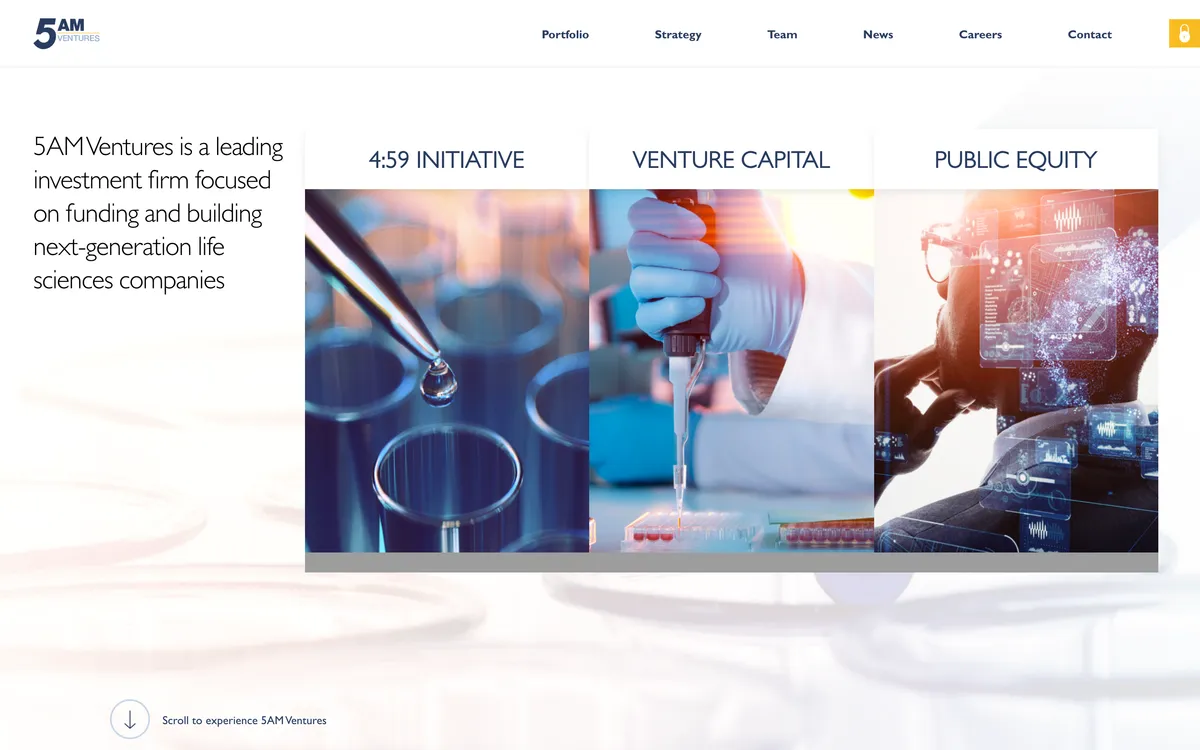
5AM Ventures is an early-stage biotech venture capital firm founded in 2002 that manages approximately $1.8 billion from the San Francisco Bay Area. The firm concentrates on therapeutic development, precision medicine, and technologies that advance drug discovery, partnering with scientific founders at formation.
Leading founding rounds and supplying hands-on operational support is how 5AM turns breakthrough science into commercial ventures. The firm takes board seats and works with founding teams to build management structures, prepare for later financings, and establish regulatory pathways.
Crinetics Pharmaceuticals shows the result, its drug Paltusotine reaching FDA approval and marking 5AM’s ability to carry early-stage innovation through development to market.
What are biotech venture capital firms?
Biotech venture capital firms are specialized investors that fund life-science and drug-development startups with capital plus scientific, operational, and incubation support. Their working knowledge spans pharmacology, clinical development, and regulatory pathways, which is what separates them from generalist venture firms, and pairing money with that support de-risks ventures that are capital-heavy and long-horizon by nature.
Classification runs along investment stage and structural model. Stage coverage spans seed and early-stage investors through those leading Series A to C and later growth rounds, while structure divides into independent venture funds, corporate venture arms, and disease-focused funds.
What types of biotech venture capital firms exist?
Biotech venture capital firms divide along two axes, investment stage and fund structure. The stage classifications are listed below:
- Seed stage: supplies initial capital for proof-of-concept work and early development.
- Series A–C: leads early institutional rounds as startups validate their science and business model.
- Early stage: concentrates on company formation and early validation, joining first rounds.
- Late stage or growth: funds clinical-stage companies approaching commercialization.
- Crossover: bridges private and public markets, backing companies near a public offering.
- Multistage: deploys across phases from formation through late-stage expansion.
The structural classifications are listed below:
- Independent specialist funds: operate autonomously, raising from limited partners to invest in biotech.
- Corporate venture arms: subsidiaries of pharmaceutical, biotech, or technology companies that invest for strategic access to innovation pipelines alongside financial return.
- Disease-focused funds: organized around therapeutic areas such as oncology, rare disease, or neurology, backed by foundations or venture-philanthropy models.
- Diversified firms: run a biotech or healthcare vertical inside a broader multi-sector platform.
Corporate Venture Capital Arms in Biotech
Corporate venture capital arms in biotech are investment entities backed by established companies, pursuing strategic and financial goals together. They give startups capital plus access to the parent’s resources, including scientific knowledge and business development routes, which separates them from independent funds chasing financial return alone.
Sanofi Ventures, F-Prime Capital, and a16z Bio+Health are prominent examples. Sanofi Ventures backs early-stage biotech and digital health companies aligned with Sanofi’s interests, F-Prime Capital runs a diversified healthcare portfolio from its historical link to Fidelity Investments, and a16z Bio+Health invests in therapeutic technologies in collaboration with corporations such as Eli Lilly.
Disease-Focused Venture Capital Funds in Biotech
Disease-focused venture capital funds in biotech invest inside named therapeutic areas such as oncology, rare and genetic disease, and neurology. Narrowing to one area builds the scientific depth that makes opportunity assessment sharper than a generalist biotech fund can manage.
Many disease-focused funds operate under venture-philanthropy or foundation models, drawing capital from patient advocacy groups, disease foundations, or philanthropic organizations alongside traditional investors. Tying returns to patient outcomes lets those funds accept longer horizons or modified return expectations, which moves treatment forward in underserved disease areas that commercial venture capital alone would not reach.
How do biotech VC firms differ from general venture capital firms?
Biotech venture capital firms differ from general venture capital firms across five dimensions rooted in how drug development actually works. The differences are listed below:
| Dimension | Biotech VC | General VC |
|---|---|---|
| Investment Horizon | Long, running 10–15 years from preclinical entry to exit, set by sequential clinical phases and regulatory review. | Shorter, closer to the standard 10-year fund lifecycle, with faster exits in software and consumer markets. |
| Primary Risk Type | Scientific and regulatory risk across efficacy, toxicity, trial design, manufacturing, and approval uncertainty. | Market and execution risk across product adoption, competition, and go-to-market fit. |
| Capital Intensity | High, since therapeutics can require tens to hundreds of millions before any revenue. | Lower, especially in software, where companies scale on less upfront capital. |
| Due-Diligence Focus | Scientific review of mechanism of action, preclinical and clinical data, intellectual property, regulatory pathway, and management team. | Business diligence on product-market fit, unit economics, traction, competition, and team. |
| Typical Exit Routes | IPOs and pharma acquisitions, usually after long development timelines. | IPOs, acquisitions, and secondary liquidity, usually on faster timelines. |
The horizon gap is structural rather than stylistic. A software startup can reach acquisition in three to five years, while a biotech needs five to ten years to produce the clinical results that support an IPO or acquisition, with roughly eight to ten years running from lab discovery to market across preclinical work, three clinical phases, and FDA review. Research from the Tufts Center for the Study of Drug Development puts the cost of carrying a single medicine to marketing approval at $2.558 billion over a period longer than a decade, and finds that only 12% of candidate drugs entering clinical trials win approval.
Scientific de-risking rather than rapid market adoption is what biotech venture capital buys, which makes it capital-intensive and dependent on specialized diligence, milestone-based financing, and regulatory planning.
How do biotech venture capital firms evaluate investment opportunities?
Biotech venture capital firms evaluate opportunities against seven criteria covering scientific and commercial viability. The criteria are listed below:
- Platform and scientific validation: novel platforms with reproducible results and potential across multiple therapeutic applications.
- Intellectual property and patent strength: patent scope, ownership clarity, and freedom to operate, which decide long-term competitive position.
- Scientific founder and management team: teams with records in drug development and regulatory work.
- Mechanism of action with preclinical and clinical data: a clear mechanism supported by rigorous preclinical evidence, with early clinical data preferred.
- Unmet need and market size: disease burden and commercial opportunity large enough to support venture-scale returns.
- Regulatory pathway: a credible route through approval and a realistic reading of the hurdles.
- Milestone structuring: funding tied to de-risking events such as IND filings or trial readouts.
How much capital do biotech venture capital firms typically invest?
Biotech venture capital firms invest across stages at round and cheque sizes that scale with clinical progress. The typical amounts are listed below:
| Funding Stage | Typical Round Size | Typical Check Size |
|---|---|---|
| Seed | $2M – $8M | $500K – $3M |
| Series A | $10M – $25M | $3M – $10M |
| Series B | $30M – $60M | $10M – $25M |
| Series C | $50M – $100M | $15M – $40M |
| Later/Growth | $100M+ | $30M+ |
Firm-level assets under management run from roughly $2 billion to above $20 billion. New Enterprise Associates manages over $25 billion across sectors, OrbiMed approximately $20 billion, ARCH Venture Partners roughly $12 billion, and Flagship Pioneering and RA Capital Management over $10 billion each, while specialist early-stage firms such as Atlas Venture and 5AM Ventures run $2.7 billion and $1.8 billion respectively.
Those figures follow from the capital intensity of drug development, which demands sustained funding through clinical validation and regulatory review before any revenue arrives. Biopharma startups raised $24.2 billion across 568 deals in 2024, against $10.1 billion across 645 deals in 2023, a rise in capital concentrated into fewer, larger rounds.
What returns do biotech venture capital firms target from their portfolio companies?
Biotech venture capital firms target fund-level multiples of 3–5x and internal rates of return between 20% and 30% across a 10–12 year fund life. Those targets reflect a sector where investments must clear scientific, regulatory, and commercial hurdles in sequence before returning anything.
Portfolio construction follows the power law, where a small number of breakthrough companies produce the majority of returns while many positions return little or fail outright.
Exits come through initial public offerings and acquisitions by pharmaceutical companies, with time-to-exit running seven to ten years from initial investment as companies work through scientific validation, clinical development, and regulatory milestones. IPOs supply liquidity with continued upside through public-market appreciation, while pharma acquisitions deliver more predictable outcomes tied to clinical milestones and strategic fit. Those are targets rather than realized outcomes. The benchmarks the asset class actually delivers, and the IRR, MOIC, DPI and TVPI measures behind them, sit in venture capital returns.
How can biotech venture capital firms increase value of their portfolio companies?
Biotech venture capital firms raise portfolio company value through six levers. The levers are listed below:
- Company creation and incubation: firms such as Flagship Pioneering and Third Rock Ventures build companies from the ground up, developing the scientific thesis, recruiting founding teams, and launching startups through incubation.
- Board seats and governance: board positions supply oversight, enforce milestones, and hold capital discipline.
- Management recruiting: firm networks bring in experienced CEOs and CFOs who accelerate development and secure later-stage financing.
- Syndication and follow-on financing: strong co-investor syndicates and follow-on support carry companies to clinical milestones.
- Pharma business-development partnerships: partnerships with pharmaceutical companies supply validation, funding options, and exit readiness.
- Operational and regulatory support: guidance on trial design, regulatory strategy, and commercialization reduces execution risk.
Marketing threads through all six rather than sitting beside them. A firm with visible authority recruits senior operators more easily, draws stronger syndicate partners, and reaches pharma business development earlier, while the profile it builds for a portfolio company carries into customer, partner, and investor conversations ahead of each round. Venture capital marketing explains how firms build that authority and amplify portfolio wins back into the firm’s own brand.
How does Venture Capital Marketing Agency increase value of biotech venture capital firms’ portfolios?
Venture Capital Marketing Agency raises the value of biotech venture capital portfolios through marketing that builds visibility and credibility. As a marketing agency for VC firms, we deploy positioning strategies that separate firms in a crowded life-sciences capital market.
Our thought-leadership work, spanning white papers and conference presentations, establishes portfolio executives as authoritative voices in therapeutic innovation, which draws higher-quality deal flow and strengthens limited partner confidence.
Our portfolio-company brand building covers corporate identity and digital presence, both of which affect valuation during fundraising and acquisition talks. Our investor relations and LP visibility programmes carry fund performance and portfolio milestones to institutional investors, extending the value-creation levers biotech venture firms already run and supporting firms such as Flagship Pioneering from formation through exit.