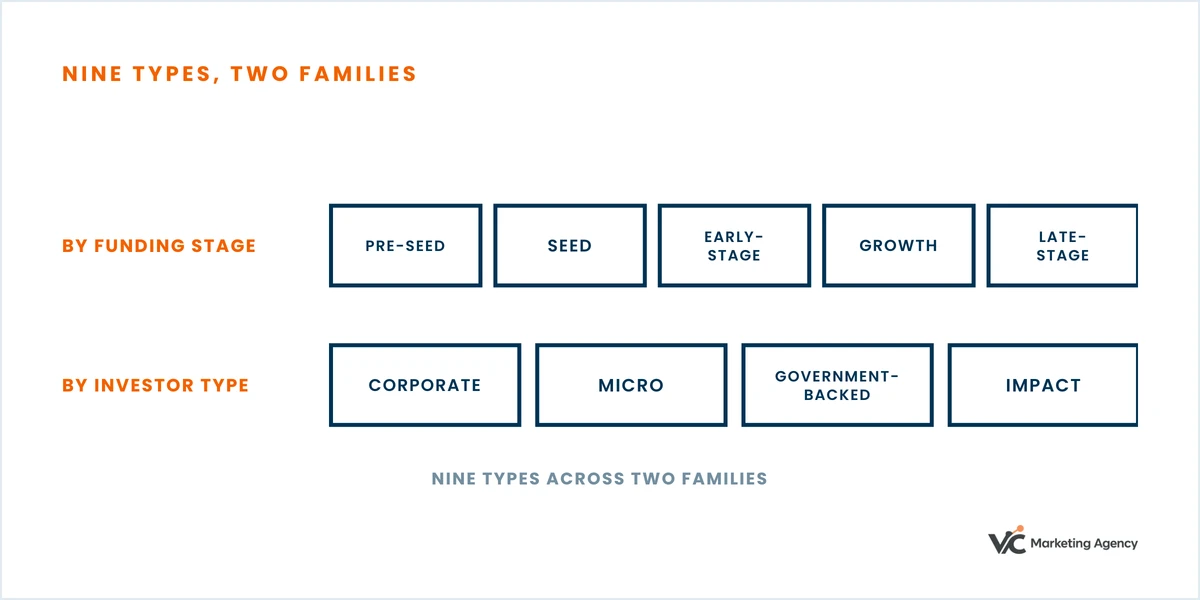
Venture capital is equity financing for high-growth, high-risk startups, and it divides into nine types across the funding lifecycle and firm structures. Venture capital runs through a general-partner and limited-partner fund model built on a long horizon and an outsized-return goal.
Five types follow the funding lifecycle. Pre-seed venture capital supplies the earliest capital for idea validation. Seed venture capital funds the first institutional round aimed at product-market fit. Early-stage venture capital backs proven traction through Series A and Series B with larger cheques and reduced risk. Growth-stage venture capital finances scaling at Series C and beyond. Late-stage venture capital serves companies approaching exit readiness in a pre-IPO position, the lowest-risk stage-based type.
Four more types divide by the kind of investor rather than by round. Corporate venture capital comes from the investment arms of large corporations pursuing strategic synergies alongside financial return. Micro venture capital covers small, thesis-driven funds concentrated on seed with smaller cheques and high deal volume. Government-backed venture capital carries a public or economic-development mandate and uses co-investment structures. Impact venture capital targets measurable social or environmental outcomes alongside returns, measured against IRIS+, the B Impact Assessment, and the UN Sustainable Development Goals.
A startup matches its stage and strategic goals to the right type by weighing the size of its capital need, its dilution tolerance, and whether strategic partnership or purely financial backing serves it better. Early-stage capital at Series A remains the hardest to reach, while the highest-performing firms separate themselves through consistent returns, operational support, and branding that draws founders and limited partners alike.
Pre-Seed Venture Capital
Pre-seed venture capital is the earliest stage of startup funding, aimed at validating a business idea or building a minimum viable product (MVP) before revenue exists. Rounds run from $50,000 to $500,000 depending on the startup’s needs and industry.
Pre-seed capital comes from founders’ savings, friends and family, angel investors, dedicated pre-seed funds, and accelerators. Y Combinator and Techstars supply capital alongside mentorship, usually structuring investments through a SAFE (Simple Agreement for Future Equity).
Dilution at pre-seed stays modest at 5% to 15%, set by the amount raised and the startup’s potential. Investors weigh the founding team and the market opportunity above all else at that stage, accepting heavy risk for the possibility of outsized returns, and the relationships formed carry strategic advice and customer introductions beyond the cheque.
Seed Venture Capital
Seed venture capital is the first institutional round of financing, aimed at reaching product-market fit. Companies move from validating an idea to demonstrating that customers will pay, funded by seed funds, micro-VCs, and angel investors writing $500,000 to $3 million.
Valuations at seed run from $3 million to $15 million pre-money, with founders giving up 10% to 25% equity. SAFEs and convertible notes are the common instruments, converting into equity at a later round, usually at a discount to the Series A price, which defers formal valuation talks until the company has traction.
Institutional seed capital funds key hires, product refinement against early customer feedback, and the beginnings of a scalable business model, which sets up the traction threshold Series A investors require.
Early-Stage Venture Capital
Early-stage venture capital covers Series A and Series B rounds, the point where a startup must show proven traction through early revenue, a growing customer base, and validated unit economics. Series A rounds run $2 million to $15 million and Series B rounds $10 million to $30 million or more.
Institutional venture firms with funds in the hundreds of millions lead at that stage, running diligence on revenue metrics, customer acquisition cost, lifetime value, retention, and competitive moat. Where seed capital bets on team and vision, early-stage capital demands evidence of product-market fit and a route to scalable unit economics, and dilution runs 15% to 25% per round as valuation shifts from qualitative judgement to revenue multiples.
Scaling defines the work at that stage: building the sales and marketing engine, hiring senior leadership, widening the product for broader segments, and sometimes preparing geographic or vertical expansion.
Growth-Stage Venture Capital
Growth-stage venture capital arrives at Series C and beyond, once a company holds established revenue and a proven business model. Cheques run from $10 million to $100 million or more, funding geographic expansion, product line diversification, and strategic acquisitions.
Risk falls at growth stage because investors can price concrete metrics: revenue growth rate, customer acquisition cost, and retention. Growth rounds overlap with growth equity, where the focus shifts to operational execution and market expansion, and companies command higher valuations at lower dilution on the strength of their de-risked profile.
Growth-stage capital funds the shift from product-led startup to professionally managed organization, covering executive hires, sales team expansion, and the compliance and governance frameworks public-market readiness requires.
Late-Stage Venture Capital
Late-stage venture capital is the final private phase before a company reaches public markets or another liquidity event. Companies at that point hold substantial revenue traction and established market positions, and the work turns to optimizing unit economics and preparing for an IPO or acquisition.
Pre-IPO positioning drives the round. Companies carry proven business models and annual recurring revenue in the tens or hundreds of millions, and attention moves from scaling operations to financial reporting and corporate governance.
Bridge and mezzanine financing are the common instruments, supplying capital while limiting dilution ahead of a public debut. Mezzanine financing, a hybrid of debt and equity, frequently serves as the last private round before an IPO.
Late-stage rounds may carry secondary share sales that give early investors and employees partial liquidity. The goal throughout is exit readiness, with late-stage investors focused on the governance and operational benchmarks public market investors expect.
Corporate Venture Capital
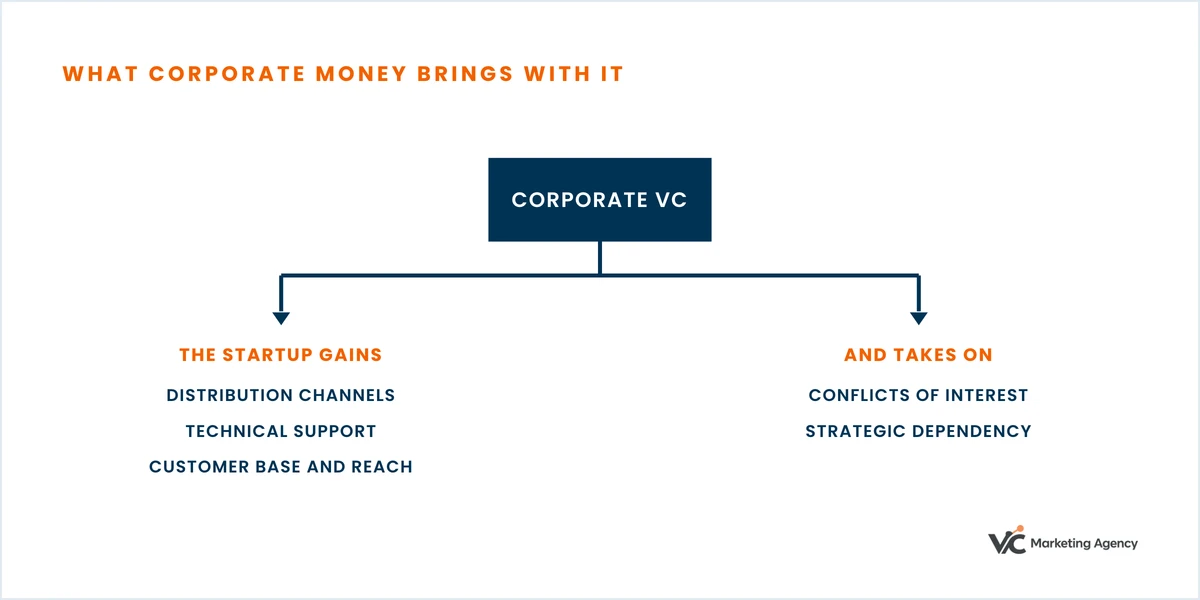
Corporate venture capital (CVC) is investment by established companies into startups through dedicated venture arms. Where traditional venture capital pursues financial return alone, CVCs chase strategic and financial objectives together, which gives the parent a read on emerging technologies and markets while the startup gains distribution channels and technical support.
Synergies run through technology access, distribution, and market reach. Corporations accelerate innovation and strengthen competitive position, while startups reach the parent’s customer base and distribution infrastructure for faster market entry. GV (Google Ventures), Intel Capital, Salesforce Ventures, and Qualcomm Ventures are prominent examples, each aligning investments with its parent’s strategic goals.
Corporate venture capital carries its own complications, including conflicts of interest and strategic dependency, which startups weigh against the access on offer before taking corporate money.
Micro Venture Capital
Micro venture capital covers funds between $10 million and $100 million concentrated on seed and pre-seed investments, writing $50,000 to $500,000 per deal. Emerging, thesis-driven managers run most micro VCs, focusing on named sectors or technologies, which lets them decide fast and hold high deal volume.
Small cheques and hands-on involvement define the category. Micro VCs work closely with founders to validate business models and reach early traction, supplying mentorship and operational support that bridges a company to larger rounds. SV Angel, Lowercase Capital, and Precursor Ventures sit among the established names.
Government-Backed Venture Capital
Government-backed venture capital is investment driven by public policy rather than return alone, aimed at stimulating economic development, building regional innovation, and closing market gaps private investors leave open. Funds concentrate on strategic sectors such as defence technology, clean energy, and biotechnology, and operate through co-investment models where public money draws private capital in by sharing risk.
Several vehicles define the category. The US Small Business Investment Company (SBIC) programme, run by the Small Business Administration, supplies government-guaranteed debt to private investment funds. The Small Business Innovation Research (SBIR) programme awards competitive R&D grants to small businesses in technology sectors tied to federal agency missions. In-Q-Tel, created by the Central Intelligence Agency, invests in technologies serving national security alongside commercial viability. In Europe, the European Investment Fund supports small and medium enterprises across member states, weighted toward climate transition, digital innovation, and inclusive growth.
Government-backed capital matters most in early-stage and deep-tech investing, where long development cycles and heavy capital requirements deter purely profit-driven investors.
Impact Venture Capital
Impact venture capital pursues financial return alongside measurable social or environmental outcomes, a double-bottom-line thesis. Environmental, social, and governance criteria sit inside the investment decision rather than beside it, and standardized frameworks such as IRIS+ and the B Impact Assessment supply a common language for measuring performance against the UN Sustainable Development Goals.
Impact funds target sectors where commercial scale and mission outcomes reinforce each other. Climate technology investment covers renewable energy, carbon capture, and sustainable agriculture. Healthcare investment covers affordable diagnostics, telemedicine, and mental health platforms. Financial inclusion covers fintech for underbanked populations and microfinance platforms. DBL Partners and Khosla Impact are representative funds.
Measurement is what separates impact venture capital from broader ESG screening. Impact investors pursue outcomes through ownership and governance and track them with consistent metrics rather than applying a screen and moving on.
What is Venture Capital?
Venture capital is a form of private equity financing supplied to startups and early-stage companies with high growth potential. The asset class runs on a general-partner and limited-partner fund model with a long horizon and an outsized-return goal, where the general partner manages the fund and makes investment decisions while limited partners supply the capital.
A venture capital fund runs roughly a ten-year lifecycle, opening with an investment period and closing with a harvest phase where returns are realized through IPOs or acquisitions.
Fund economics rest on a management fee of around 2% of assets under management plus carried interest of about 20% of profits, which ties general partner compensation to performance. A study of 238 funds raised between 1993 and 2006 found roughly two-thirds of a manager’s expected revenue comes from fixed fee components rather than performance-based carry, according to “The Economics of Private Equity Funds” by Andrew Metrick and Ayako Yasuda, published in the Review of Financial Studies, June 2010. Beyond capital, venture capitalists supply strategic direction and operational support to portfolio companies. The risk and return profile is steep, with many investments failing and a few producing returns large enough to carry the fund under a power-law distribution. Those mechanics are covered end to end in venture capital, including how the asset class differs from angel investing and private equity.
What are some examples of venture capital types?
Each venture capital type has recognizable firms or funds that exemplify it. The examples are listed below:
- Traditional or institutional venture capital: Sequoia Capital and Andreessen Horowitz, investing across stages from seed to growth in technology and healthcare.
- Pre-seed venture capital: Y Combinator and Techstars, supplying pre-seed funding, mentorship, and structured programmes for idea validation and MVP work.
- Seed venture capital: micro-VCs and dedicated seed funds writing first institutional cheques from $50,000 to $500,000 toward product-market fit.
- Early-stage venture capital: Series A and Series B investors funding startups with proven traction to scale go-to-market and expand teams.
- Growth-stage venture capital: growth equity funds at Series C and beyond, backing established revenue with market and geographic expansion capital.
- Late-stage venture capital: late-stage specialists supplying bridge and mezzanine capital to pre-IPO companies preparing for liquidity.
- Corporate venture capital: GV (Google Ventures), Intel Capital, Salesforce Ventures, and Qualcomm Ventures, combining financial return with strategic access to parent company resources.
- Micro venture capital: emerging managers running $10 million to $100 million funds on thesis-driven seed investing at high deal volume.
- Government-backed venture capital: the SBIC programme, SBIR grants, In-Q-Tel, and the European Investment Fund, built to stimulate economic development and support strategic sectors.
- Impact venture capital: funds pursuing double-bottom-line returns measured against IRIS+, the B Impact Assessment, and the UN Sustainable Development Goals, targeting climate technology and healthcare access.
What is the Difference Between Venture Capital and Private Equity?
Venture capital differs from private equity across seven dimensions covering company stage, ownership, deal size, risk, value creation, leverage, and exit. The differences are listed below:
| Dimension | Venture Capital | Private Equity |
|---|---|---|
| Company Stage and Maturity | Early-stage to growth-stage startups with high growth potential and limited operating history | Mature, established, usually profitable companies |
| Ownership Stake Taken | Minority stake, without taking control | Majority or controlling stake, usually through a buyout |
| Typical Deal Size | Smaller equity investments staged across seed through late stage | Larger transactions, sized to acquire control |
| Source of Risk | Business-model and execution risk, with returns depending on a few breakout winners | Lower stage risk, with returns driven by operational improvement and financial restructuring |
| Value-Creation Model | Scaling through hiring, product development, and go-to-market support | Operational improvement, strategic repositioning, and growth optimization |
| Use of Leverage | Rarely uses meaningful debt at deal level | Commonly uses leverage, especially in buyouts |
| Exit Routes | IPOs, acquisitions, and secondary sales | IPOs, strategic sales, secondary sales, and recapitalizations |
Venture capital finances young companies with high growth potential through minority equity positions, while private equity acquires control of mature businesses and combines equity with debt to build value through operational change.
How to Choose the Right Type of Venture Capital for a Startup?
A startup chooses the right type of venture capital by matching four factors: its funding stage, the size of its capital need, its strategic objectives, and its dilution tolerance.
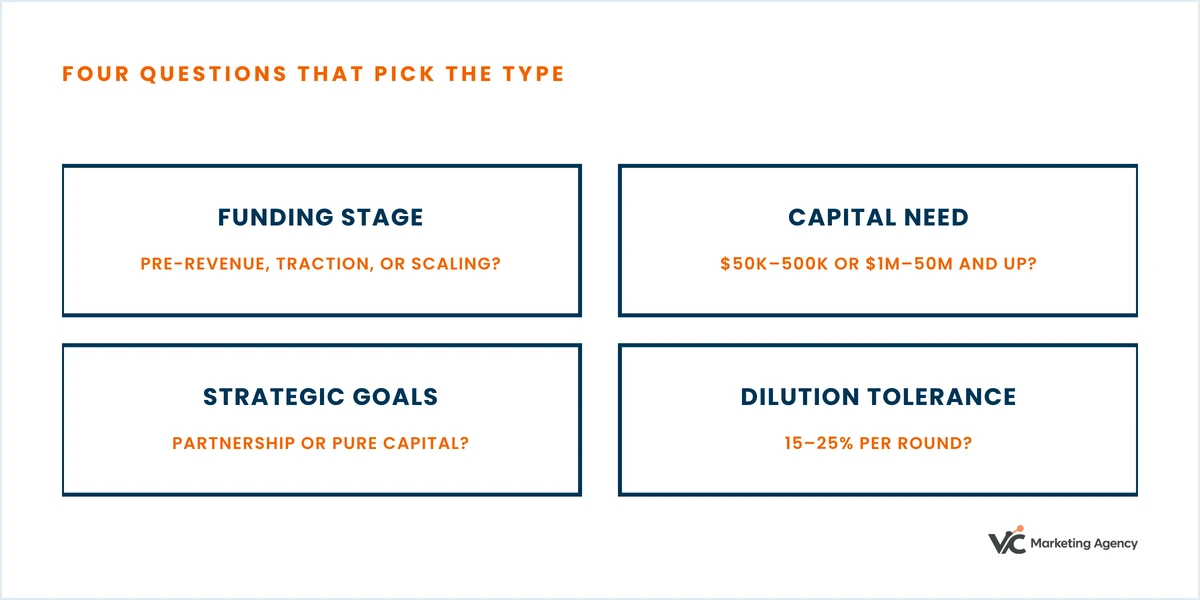
Funding stage sets the starting point. Pre-revenue startups seek pre-seed or seed capital, startups with proven traction pursue Series A or B, and scaling businesses with established revenue target growth-stage or late-stage capital.
Capital need narrows the field further. Micro VCs and angels write $50,000 to $500,000 while institutional VCs write $1 million to $50 million or more, and a startup has to match its raise size to an investor’s typical cheque range.
Strategic objectives decide the investor type. A startup that needs distribution channels, R&D resources, or partnership access should weigh corporate venture capital, which pairs funding with parent-company synergies, while traditional institutional VCs supply capital and ownership without an embedded strategic agenda. Dilution tolerance runs alongside, since early-stage equity financing costs 15% to 25% per round. Sector fit closes the decision, and impact-driven startups in climate, health, or financial inclusion should pursue impact venture capital or government-backed funds.
What Type of Venture Capital is Best for a Pre-Revenue Startup?
The best venture capital for a pre-revenue startup is pre-seed and seed capital, alongside angel investors. Those sources supply what a company needs to validate a concept or build a minimum viable product.
Pre-seed capital arrives from founders, friends and family, angel investors, and dedicated pre-seed funds. Seed venture capital follows as the first institutional round aimed at product-market fit, and angel investors add mentorship to the capital at both points.
What Type of Venture Capital is Best for a High-Growth SaaS Startup?
The best venture capital for a high-growth SaaS startup is early-stage and growth-stage institutional capital. Series A and B funding scales operations, expands sales teams, and builds engineering capacity for companies that have reached product-market fit and hold early recurring revenue.
Growth-stage capital at Series C and beyond funds market expansion, geographic scaling, and the route to profitability. Both stages suit the predictable recurring revenue of SaaS, which is what draws institutional investors focused on scalable models and clear unit economics.
What Type of Venture Capital is Best for a Startup Seeking Strategic Partnerships?
The best venture capital for a startup seeking strategic partnerships is corporate venture capital. Corporate arms supply funding plus access to distribution channels, technology, and market knowledge.
GV (Google Ventures), Intel Capital, and Salesforce Ventures let startups build synergies that reach past the cheque, opening market entry and operational collaboration a purely financial investor cannot offer.
What Type of Venture Capital is Best for an Impact-Driven Startup?
The best venture capital for an impact-driven startup is impact venture capital, which pursues financial return alongside measurable social or environmental outcomes. Impact funds assess companies against IRIS+, the B Impact Assessment, and the UN Sustainable Development Goals across climate, healthcare, and financial inclusion.
Government-backed venture capital is the alternative where a startup’s goals line up with public economic-development initiatives or innovation-policy mandates.
What is the Most Competitive Type of Venture Capital to Access?
The most competitive type of venture capital to access is early-stage capital at Series A. Demand concentrates there as startups move from concept validation to scaling, and three factors drive the squeeze.
Deal-flow scarcity comes first, since only a small share of startups reach the traction and product-market fit Series A requires. Concentration among brand-name firms compounds it, as a handful of top-tier firms hold the reputation, networks, and capital to win the strongest deals.
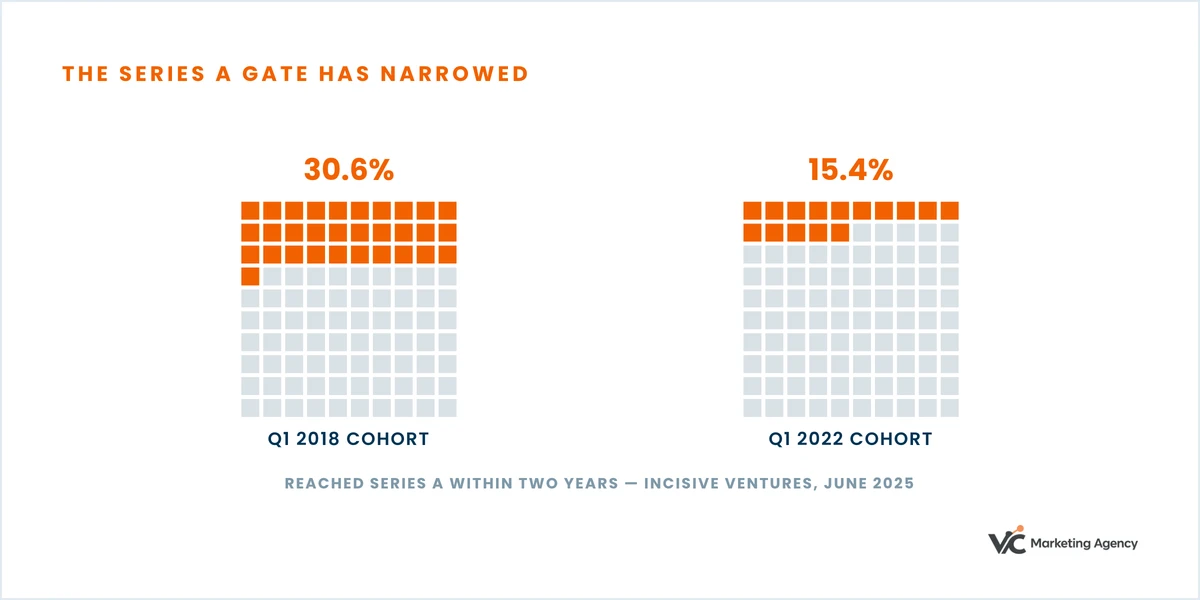
Heightened selectivity completes the picture. Investors at Series A require clear evidence of market traction and durable growth, and cohort data shows how narrow the gate has become. Carta and PitchBook cohort records put the seed-to-Series-A conversion rate at roughly 15% to 20%, down from about 50% across the 2018 to 2021 cycle, and analysis published by Incisive Ventures in June 2025 found that 30.6% of companies raising a seed round in the first quarter of 2018 reached Series A within two years against 15.4% of the first-quarter 2022 cohort.
What are the Highest-Performing Venture Capital Firms?
The highest-performing venture capital firms deliver returns through repeatable selection and support rather than single lucky positions. The leading firms and their performance drivers are listed below:
Sequoia Capital. Sequoia backed Apple, Google, and Airbnb early, and its results rest on pattern recognition, founder relationships, and a multi-stage fund structure carrying companies from seed to IPO. Bloomberg reported in December 2020 that Sequoia’s 2003, 2006, and 2010 funds returned roughly 8x, 10.9x, and 11.1x net of fees.
Andreessen Horowitz (a16z). a16z runs a platform model supplying portfolio companies with recruiting, marketing, and business development support, with investment focus across crypto, bio, and enterprise software. Fund documents place its first fund at 11.3x net TVPI as of 30 September 2025 and its 2012 Fund III at 9.4x, with more than $25 billion returned to investors since 2009, according to reporting by Eric Newcomer, September 2025.
Benchmark Capital. Benchmark writes fewer, larger cheques into companies such as eBay, Twitter, and Uber, and its equal-partnership structure removes internal hierarchy and misaligned incentives.
Accel. Accel backed Facebook, Slack, Dropbox, and Spotify, working from sector specialization in SaaS and consumer internet and a research-driven approach to finding category-defining companies before consensus forms.
Founders Fund. Founders Fund invests on contrarian, science-driven theses in zero-to-one companies including SpaceX, Palantir, and Stripe, concentrating on frontier technology rather than incremental improvement.
Lightspeed Venture Partners. Lightspeed pairs consumer and enterprise coverage with presence across the US, China, India, and Europe, and its speed in decision-making wins competitive rounds.
Kleiner Perkins. Kleiner Perkins backed Amazon, Google, and Genentech, and more recently Uber and Spotify, working from an early Silicon Valley position, technical diligence, and long-term company building.
Why Do the Best Venture Capital Firms Invest in Marketing and Branding?
The best venture capital firms invest in marketing and branding because both decide which deals they see and which limited partners commit. A strong brand raises visibility and reputation, and those two things bring high-potential startups to the firm rather than the reverse.
Branding signals a firm’s investment thesis, domain command, and the value it adds past capital, which makes it the preferred choice for founders looking for a strategic partner rather than a cheque.
Positioning of that kind marks a firm as a leader in a crowded market, which eases both deal flow and fundraising and compounds across successive funds. The discipline behind it, from thought leadership through to LP communications, is venture capital marketing.
How Does Marketing Help Venture Capital Firms Attract Startups and LPs?
Marketing helps venture capital firms attract startups and limited partners by building visibility and credibility on both sides of the funnel. For startups, a strong brand reduces friction in sourcing, since founders seek out firms with established reputations, which lets top-tier firms reach competitive deals earlier and on better terms.
For limited partners, marketing builds trust and separation, signalling fund performance and operational discipline to institutional investors, family offices, and high-net-worth individuals weighing a commitment.
Both effects compound. A firm known for a clear thesis sees better companies earlier, and better companies produce the track record that makes the next fundraise easier. Running both sides of that funnel consistently is what a digital marketing agency for venture capital firms is built to do.